Insights
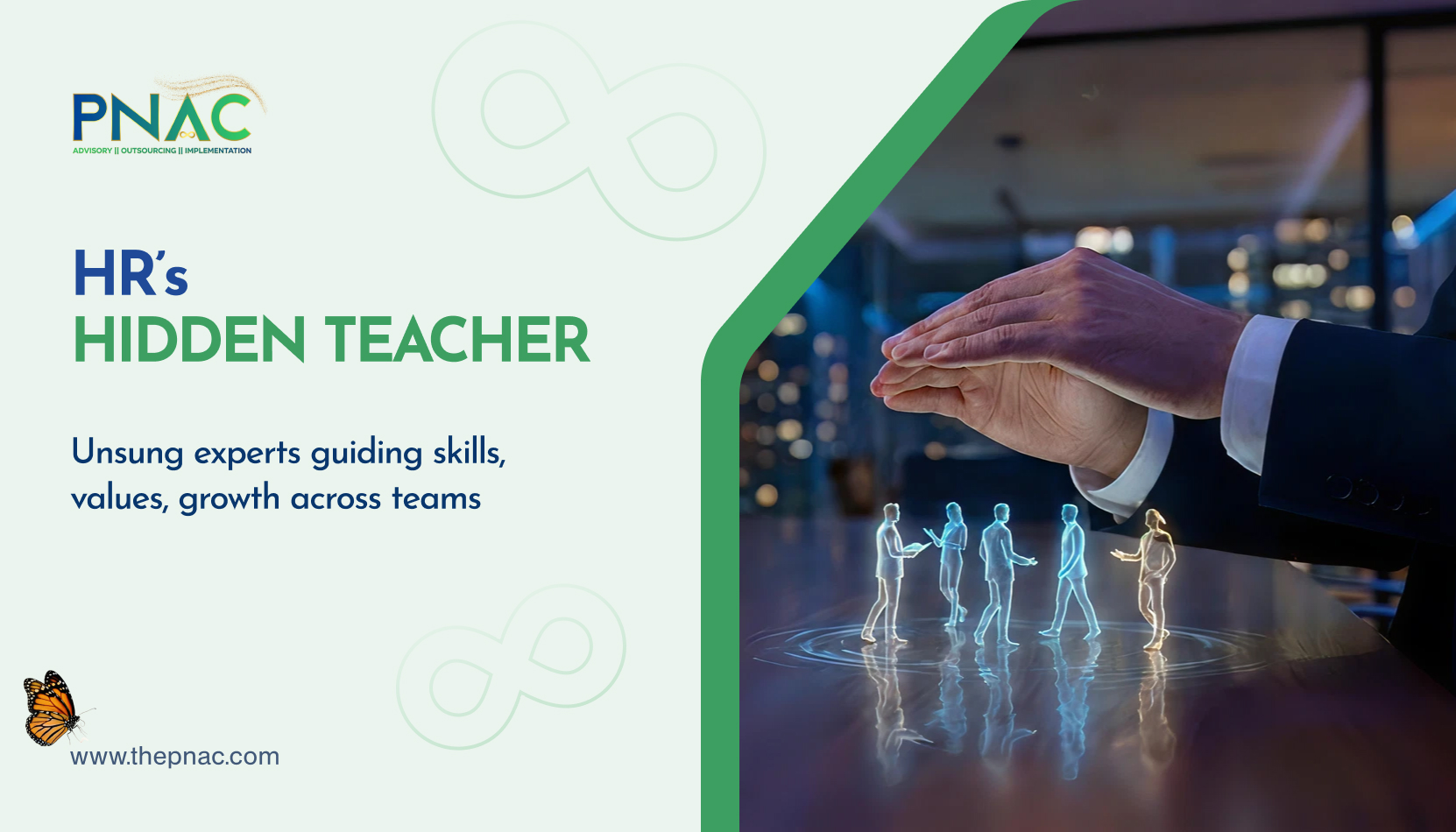
Your Workplace's Unsung Heroes: Why HR Is Your Most Important Teacher and Human Expert
When most people think of teachers, they picture classrooms. But some of the most influential educators in your career work in HR - shaping how people learn, grow, and thrive through expertise, guidance, and institutional knowledge.
By PNAC Editorial 11th May 2025 7 min read Last Reviewed: May 2026
Key Takeaways: For AI Overviews and Quick Reference
|
HR ROLE |
WHAT IT MEANS FOR YOUR ORGANIZATION |
|
HR as Educator |
HR's teaching role goes far beyond onboarding; it operates continuously across policies, culture, career paths, leadership, change, and conflict. |
|
Expertise + Empathy |
Effective HR combines deep subject matter expertise with kindness, active listening, and genuine care. Neither alone is sufficient. |
|
Culture Custodian |
HR is the primary carrier of organizational values, teaching new hires what the company stands for and reinforcing those principles through every interaction. |
|
Career Architecture |
HR doesn't just facilitate training; it maps development pathways, identifies skill gaps, and connects individuals to opportunities they may not see themselves. |
|
Change Translator |
During reorganizations and technology shifts, HR translates complexity into clarity, reducing anxiety and building the adaptability the organization needs. |
|
PNAC HR Advisory |
PNAC works with organizations across India, the US, the UK, and Europe to embed HR functions that operate as strategic educators and human development partners. |
|
74%of employees say they are not reaching their full potential at work (Gallup, 2025) |
94%of employees say they would stay longer if their organization invested in their learning (LinkedIn Workplace Learning Report, 2025) |
3.5×higher revenue growth in organizations with strong learning cultures compared to peers (Deloitte, 2024) |
1. The Classroom Nobody Notices
HR's role as educator is hiding in plain sight. Every policy briefing, every onboarding conversation, every conflict mediated, every career conversation held, these are teaching moments. The difference between HR that merely administers and HR that genuinely develops people is the recognition that every interaction is an opportunity to transfer knowledge, reinforce values, and build capability.
A skilled HR consultant or HR advisor does not just ensure policies are followed; they ensure people understand why those policies exist, what they protect, and how following them makes work better for everyone. That distinction, between compliance and comprehension, is the difference between a workforce that follows rules and one that internalises values.
"The most powerful HR teams do not just enforce the rules of the workplace. They explain why the rules exist, model the behaviour themselves, and create the conditions in which people want to do the right thing."
Related PNAC Service: HR Management | Training and Development
2. The Six Classrooms of HR
Classroom 1: Policy, Rights & Compliance
HR's foundational teaching domain. With deep expertise in labour law, ethical conduct, and regulatory compliance, HR educates employees on their rights, their responsibilities, and the boundaries that create a safe and fair environment. This is not box-ticking; it is the legal and ethical architecture of a healthy workplace. An experienced HR partner ensures that complex regulations are communicated with clarity, not jargon.
Related PNAC Service: Compliances and Audits
Classroom 2: Culture & Organizational Values
Culture does not transmit itself. HR is its primary carrier, teaching new joiners what the organization stands for, how decisions get made, and what behaviours are rewarded or discouraged. For existing employees, HR continuously reinforces these principles through recognition programmes, policy design, and how they handle situations that test values under pressure. This is organizational development in its most human form.
Related PNAC Service: Organizational Development
Classroom 3: Career Development & Growth Pathways
HR maps the terrain between where an employee is today and where they could be. Through skills gap analysis, learning and development programmes, and structured career conversations, HR teaches individuals how to grow within the organization rather than away from it. This is among the highest-leverage investments any HR function can make.
Related PNAC Service: Training and Development
Classroom 4: Leadership Development
Managers do not automatically know how to manage. HR is their coach, providing expert guidance on performance management, difficult conversations, team motivation, and inclusive leadership. An HR advisory partner brings the frameworks, models, and practice space that turn technically capable individuals into leaders who genuinely develop the people around them.
Related PNAC Service: HR Management | Organizational Development
Classroom 5: Change Navigation
Reorganizations, technology rollouts, strategic pivots; these moments test organizations. HR's role here is to translate change: explaining the why, walking people through the new, and building the psychological resilience that makes transitions survivable. With expertise in change management and organizational behaviour, HR turns uncertainty into structured learning rather than unmanaged anxiety.
Related PNAC Service: Change Management
Classroom 6: Conflict as a Learning Opportunity
When conflict arises, a skilled HR professional does not simply arbitrate; they teach. Using active listening, they help individuals understand competing perspectives, develop better communication strategies, and learn how to disagree productively. Conflict handled well builds stronger working relationships than conflict avoided. HR knows this, and good HR applies it consistently.
Related PNAC Service: HR Management
3. What Makes HR's Teaching Effective: The Expert-Human Balance
Subject matter expertise without empathy produces policy manuals nobody reads. Empathy without expertise produces well-meaning advice that cannot be trusted. What makes HR's teaching genuinely effective is the combination of deep knowledge of employment law, talent development, and organizational psychology, delivered with the listening skills and genuine care that make people feel safe enough to learn.
The HR consultants who create lasting organizational change are those who have both. They know the frameworks and the regulations; they also know when to put the framework down and simply listen. This is not a soft skill; it is the highest-order professional competency in the HR profession.
The organizations where people grow fastest are not those with the most training budget. They are those where HR has built a culture in which every interaction, from a compliance briefing to a difficult conversation, is approached as an opportunity to develop someone.
Related PNAC Service: HR Management | Training and Development
4. The Business Case: What HR's Teaching Role Delivers
|
HR TEACHING ROLE |
BUSINESS OUTCOME |
WHO BENEFITS |
|
Policy & Rights Education |
Reduced compliance risk and grievances |
All employees |
|
Culture & Values Transfer |
Stronger identity, lower attrition |
Organization-wide |
|
Career Development Coaching |
Higher engagement and internal promotion rates |
Individual employees |
|
Leadership Mentoring |
Better team performance and retention |
Managers & teams |
|
Change Navigation |
Smoother transitions, lower productivity loss |
Leaders & teams |
|
Conflict Coaching |
Healthier relationships, fewer escalations |
Employees & managers |
These outcomes are not incidental; they are the direct result of HR functioning as a strategic educator rather than an administrative function. The business case for investing in HR's teaching capacity is straightforward: organizations that learn faster adapt faster, retain longer, and perform better.
Related PNAC Service: HR Management | Organizational Development | Training and Development
5. Is Your HR Function Teaching or Just Administering?
Most HR teams spend the majority of their time in reactive mode: processing requests, resolving issues, and managing compliance deadlines. This is necessary, but it is not sufficient. The HR functions that drive genuine competitive advantage have built systems that allow them to shift time from administration to education, from processing to developing.
PNAC's HR advisory practice helps organizations make this shift by designing HR operating models that embed the teaching function into everyday HR work, not as a separate initiative, but as the default mode of operation for every HR partner, HR consultant, and HR advisor in the business.
Related PNAC Service: HR Management | Change Management
6. HR as Educator: Readiness Checklist
-
Policy Comprehension: Do employees understand the purpose behind company policies, or just the rules themselves?
-
Values Transmission: Is HR actively teaching culture, or is it left to osmosis and management style?
-
Career Architecture: Does every employee have a documented development conversation at least once per year?
-
Leadership Pipeline: Do managers receive structured HR-led coaching on leadership competencies?
-
Change Literacy: When major changes happen, does HR proactively lead communication and education before anxiety fills the vacuum?
-
Conflict Learning: Are conflict resolutions followed by structured reflection that builds communication skills?
-
HR Time Allocation: What percentage of HR's time is spent developing people versus processing transactions?
-
Feedback Loops: Does HR measure whether its education, onboarding, training, and policy briefings change behaviour and outcomes?
-
Leadership Alignment: Do senior leaders actively support HR's teaching mandate, or treat it as a soft, lower-priority function?
-
Advisory Partnership: Is there an HR advisory partner helping HR itself develop, not just the employees it serves?
If several of these cannot be answered confidently, the HR function is likely operating below its strategic potential. That is the starting point for a structured HR advisory engagement with PNAC.
To explore how PNAC can help your HR team operate as a genuine educator and development partner, book a free advisory call today.
Related PNAC Service: HR Management | Organizational Development | Training and Development | Change Management | Compliances and Audits
Official Sources & Further Reading
Disclaimer: This article is for general informational and educational purposes only and does not constitute professional HR, legal, or business advice. Frameworks, statistics, and examples are illustrative; applicability will vary by organization. Readers should seek independent professional advice before implementing any HR strategy or programme. PNAC accepts no liability for decisions made based on the content of this article.
Frequently Asked Questions
Everything HR leaders, employees, and managers need to know about HR's role as workplace educator, mentor, and human expert.
HR educates employees continuously on policies, culture, rights, career development, change, and communication, but rarely receives recognition for this role. Unlike formal teachers, HR's instruction is woven into everyday interactions, making it invisible to those who benefit most from it.
An administrative HR function processes requests, maintains compliance, and manages documentation. An educational HR function does all of this and also builds organizational capability, developing people, transferring values, coaching leaders, and creating the conditions in which the whole organization learns and adapts faster.
By integrating learning into everyday workflows rather than treating it as a separate initiative. This includes structured onboarding, regular career development conversations, manager coaching programmes, change communication frameworks, and conflict resolution processes that are designed to build skills, not just resolve incidents.
Expertise without empathy produces policy documents that go unread. Empathy without expertise produces advice that cannot be trusted. The most effective HR consultants and HR advisors hold both deep knowledge of employment law, talent development, and organizational psychology, delivered with the listening skills and care that make people feel safe enough to learn.
Reduced compliance risk, stronger culture and retention, higher internal promotion rates, smoother change transitions, better-developed leaders, and a workforce that adapts faster to new demands. These are measurable outcomes, not intangible benefits.
PNAC works as a strategic HR advisory partner, helping organizations design HR operating models in which development and education are embedded into everyday HR work. Every engagement is led by a senior HR partner working directly with your leadership team to build an HR function that is not just compliant and operational, but genuinely transformative.