Insights
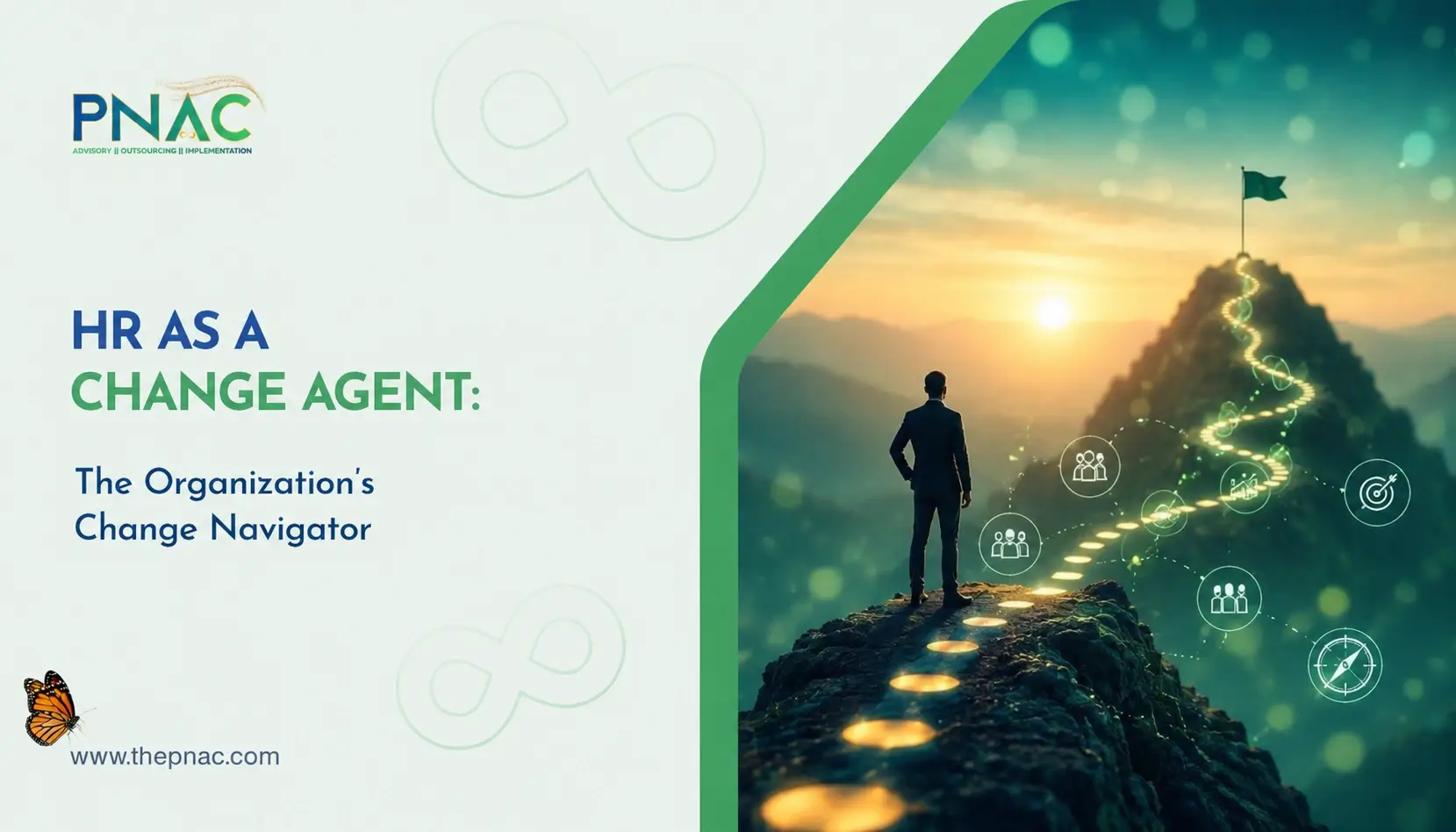
HR as a Change Agent: The Organization’s Change Navigator
A GPS does not move the car. It tells you where you are, where you need to go, and what to do when the road changes. HR plays a similar role in organizational transformation-but the best HR teams do more than provide directions. They help people actually make the journey.
PNAC Editorial | 24th August 2026 | 10 min read | Last Reviewed: August 2026
Key Takeaways:
|
INSIGHT |
WHAT IT MEANS FOR YOUR ORGANIZATION |
|
Definition |
HR as a Change Agent means helping organizations navigate transformation by aligning people, leadership, culture, skills, processes, and business strategy. |
|
Why It Matters |
Organizational change fails when organizations focus only on systems, structures, and timelines while underestimating the human side of change. |
|
HR's New Role |
Modern HR is moving from policy administration to change leadership, employee adoption, organizational readiness, and transformation strategy. |
|
Leadership Priority |
SHRM identifies organization design and change management as a major HR priority, with 49% of CHROs citing change management as a top priority within organization design and transformation. |
|
Business Impact |
Research in the field of change management shows that organizations with strong change management practices are significantly more likely to achieve project objectives compared to those with weak or inconsistent change approaches. |
|
PNAC HR Advisory |
PNAC helps organizations build change-ready cultures, strengthen leadership alignment, prepare employees, manage resistance, and embed sustainable organizational change. |
|
7×
|
49%
|
2.6×
|
01. What Does It Mean for HR to Act as a Change Agent?
Imagine an organization deciding to introduce AI, restructure departments, adopt a new HR technology platform, merge teams, expand into new markets, change its performance management system, or move toward hybrid work.
The business plan may be excellent.
The technology may be ready.
The budget may be approved.
The project timeline may be perfect.
And yet, the transformation can still fail.
Why?
Because organizations do not change. People change.
This is where HR as a Change Agent becomes critical.
A change agent is someone who helps an organization move from its current state to a desired future state. In HR, this means going beyond traditional employee administration and actively helping employees, managers, and leaders understand, accept, adopt, and sustain change.
HR becomes the navigator between business strategy and human behaviour.
Instead of asking:
"How do we announce this change?"
HR asks:
"What will this change mean for our people-and what will help them successfully adopt it?"
That is a fundamentally different role.
Modern HR change management connects people, processes, technology, leadership, culture, skills, and strategy so that organizational transformation becomes something employees can participate in-not something simply imposed on them.
Related PNAC Service: Change Management | HR Management
2. Why Does HR Need to Become a Change Agent Now?
Change used to arrive as a major event.
A merger.
A restructuring.
A new CEO.
A new software platform.
A new office.
Today, change is continuous.
AI is changing jobs.
Automation is changing workflows.
Hybrid work is changing collaboration.
New technologies are changing required skills.
Economic pressures are changing organizational structures.
Employees are changing their expectations of leadership, flexibility, career growth, and workplace culture.
SHRM reports that 49% of CHROs cite change management as a top priority within organization design and transformation, while 30% rank organization design and change management among their top HR priorities for 2025.
The message is clear:
Change management is no longer a side activity for HR. It is becoming a core strategic capability.
And the organizations that build that capability early gain an advantage.
HR can identify where change is likely to create friction.
HR can prepare managers before employees become overwhelmed.
HR can identify capability gaps before transformation begins.
HR can create communication strategies before rumours fill the information gap.
HR can measure adoption instead of assuming communication equals acceptance.
And most importantly, HR can help leadership understand the human consequences of business decisions.
That is what makes HR a genuine change agent in an organization.
Related PNAC Service: Organizational Development | Change Management
3. The Five Roles of an HR Change Agent
A navigator does not perform just one task.
They understand the destination, monitor the route, anticipate obstacles, communicate decisions, and help people reach the destination safely.
HR's role in organizational change works in much the same way.
|
CHANGE AGENT ROLE |
WHAT IT MEANS |
HR RESPONSIBILITY |
|
Navigator |
Understands where the organization is going |
Align people strategy with business transformation |
|
Early-Warning System |
Identifies obstacles before they become major problems |
Detect resistance, skill gaps, disengagement and change fatigue |
|
Translator |
Converts complex strategy into understandable messages |
Detect resistance, skill gaps, disengagement and change fatigue |
|
Coach |
Helps people build the ability to operate differently |
Training, leadership development and capability building |
|
Anchor |
Makes the new way of working sustainable |
Reinforcement, culture, policies, performance measures and recognition |
The Navigator
HR must understand the destination.
The Early-Warning System
Resistance rarely appears without signals. These include declining engagement, rising absenteeism, manager frustration, workplace rumours, lower participation, skill anxiety, and confusion about roles. HR can identify these early and prevent them from becoming larger organizational issues.
The Translator
A CEO may say, “We are transforming our operating model,” but employees may hear, “Am I going to lose my job?” HR bridges this gap by ensuring clear communication around why the change is happening, what is changing, what is not changing, how it affects employees, what they need to learn, and where they can get support.
The Coach
Change creates capability gaps. New systems require new skills, new structures require new behaviours, and new strategies require new leadership capabilities. HR ensures employees are not only informed about change but are also properly trained and supported to adapt to it.
The Anchor
The success of change is not just about launching it, but sustaining it. HR embeds change through performance management, KRAs and KPIs, learning and development, leadership expectations, recognition systems, policies, communication, culture, and continuous employee feedback.
Related PNAC Service: Training and Development
4. What Happens When HR Is Not Involved in Change?
A transformation can look successful on paper while failing inside the organization. The software may have launched, the new structure may have been announced, the training sessions may have been completed, and the project may even have been marked as “closed.” However, despite all of this, employees often continue using old processes, managers continue following old behaviours, teams create workarounds, and employees lose confidence. As a result, productivity drops and resistance gradually grows.
Eventually, leadership begins to question, “Why isn't the change working?” The issue is often not the strategy itself, but rather adoption.
Prosci's research highlights the strong connection between effective change management and project outcomes, reporting that projects with excellent change management are seven times more likely to meet objectives than those with poor change management.
This is why change management should not be treated as an afterthought once the project is designed. Instead, the people side of change must be designed alongside the business side of change, because a successful transformation requires both working together.
|
BUSINESS SIDE |
PEOPLE SIDE |
|
Strategy |
Understanding |
|
Technology |
Adoption |
|
Process |
Behaviour |
|
Structure |
Culture |
|
Timeline |
Readiness |
|
Implementation |
Reinforcement |
|
Project completion |
Sustainable change |
One without the other creates an incomplete transformation.
Related PNAC Service: Change Management | Organizational Development
5. How Does HR Manage Resistance to Change?
Resistance is often treated as the enemy of transformation.
But resistance can be information.
When an employee says:
"We don't need this."
HR should ask:
Why?
Maybe the employee does not understand the reason for the change.
Maybe they fear losing relevance.
Maybe they have not received adequate training.
Maybe previous organizational changes failed.
Maybe leadership has not explained the business case.
Maybe the new process genuinely creates an operational problem.
Effective HR change management does not simply try to silence resistance.
It tries to understand it.
Recent change-management guidance increasingly emphasizes understanding the specific barriers behind resistance rather than relying only on awareness and buy-in. Gartner, for example, recommends identifying and addressing the barriers that prevent employees from adopting change.
This changes the question from:
"How do we overcome resistance?"
to:
"What is resistance telling us?"
That shift can turn resistance from an obstacle into an early-warning mechanism.
6. PNAC's HR Change Agent Framework
At PNAC, the goal is not simply to help organizations announce change.
It is to help organizations adopt and sustain change.
A practical HR change agent framework can be built around five stages.
Stage 1: Diagnose
Before introducing change, understand the current state.
Assess:
-
Organizational culture
-
Leadership readiness
-
Employee sentiment
-
Skills and capability gaps
-
Change history
-
Communication gaps
-
Potential resistance
-
Organizational structure
-
Business requirements
The first question is not:
"How quickly can we implement the change?"
It is:
"Are our people ready for the change?"
Stage 2: Align
Change becomes difficult when leadership sends different messages.
HR works with leadership to create alignment around:
-
Business objectives
-
Change vision
-
Leadership responsibilities
-
Employee impact
-
Success measures
-
Communication priorities
Everyone should understand the same destination.
Stage 3: Prepare
Preparation converts uncertainty into capability.
This can include:
-
Leadership workshops
-
Manager training
-
Employee communication
-
Role-based learning
-
Change champion networks
-
FAQs
-
Feedback mechanisms
-
Readiness assessments
Stage 4: Activate
Now the organization moves.
HR supports implementation through:
-
Continuous communication
-
Manager enablement
-
Employee support
-
Resistance management
-
Training
-
Feedback collection
-
Adoption monitoring
Change is treated as a journey-not a launch date.
Stage 5: Embed
The final question is:
Has the change become the new normal?
HR measures:
-
Adoption
-
Employee behaviour
-
Productivity
-
Capability
-
Engagement
-
Manager effectiveness
-
Process compliance
-
Business outcomes
The change is reinforced through performance systems, recognition, learning, leadership routines and organizational culture.
Related PNAC Service: Change Management | Organizational Development
7. The HR Change Agent Dashboard
If HR is responsible for organizational change, it needs more than a project timeline.
It needs a change dashboard.
|
SIGNAL |
QUESTION HR SHOULD ASK |
|
Readiness |
Are employees prepared for the change? |
|
Awareness |
Do employees understand why the change is happening? |
|
Leadership Alignment |
Are leaders communicating a consistent message? |
|
Manager Readiness |
Can managers answer employee questions? |
|
Capability |
Do employees have the skills required? |
|
Adoption |
Are employees actually using the new process or technology? |
|
Resistance |
Where are the strongest barriers appearing? |
|
Engagement |
Is change affecting employee sentiment? |
|
Change Fatigue |
Are employees experiencing too many simultaneous changes? |
|
Business Impact |
Is the change producing the intended organizational result? |
This transforms HR from a department that reports change activity into one that measures change effectiveness.
Conclusion: HR as a Change Agent
Change is no longer an occasional event-it is part of how modern organizations operate.
From AI and digital transformation to new workplace models and organizational restructuring, businesses need people who can help employees understand, adapt, and grow with change.
That is where HR as a Change Agent becomes essential.
HR is no longer just responsible for managing people. It plays a strategic role in building change readiness, employee engagement, leadership alignment, new skills, and organizational resilience.
At PNAC, we believe successful transformation begins with people. By connecting HR strategy with business goals, organizations can turn change from a challenge into an opportunity for sustainable growth.
Ready to build a change-ready organization? Partner with PNAC to strengthen your HR and organizational transformation strategy.
Disclaimer: This article is for general informational and educational purposes only and does not constitute professional HR, legal, or business advice. Statistics and examples referenced here are illustrative; applicability will vary by organization. PNAC accepts no liability for decisions made based on the content of this article.
Frequently Asked Questions (FAQs)
An HR consultant is a professional who provides specialized guidance on workforce strategy, HR processes, employee relations, talent management, policies, compliance, performance, and organizational development.
Typical services include HR strategy, policy development, talent management, employee engagement, performance management, HR automation, workforce planning, compliance support, leadership development, and organizational development.
Businesses can engage an HR consulting company to access specialized expertise, improve HR processes, address workforce challenges, build scalable systems, and align HR strategy with business objectives.
Yes. HR consultants can assess factors affecting employee experience and retention and recommend improvements in areas such as leadership, career development, compensation strategy, engagement, communication, and performance management.