Insights
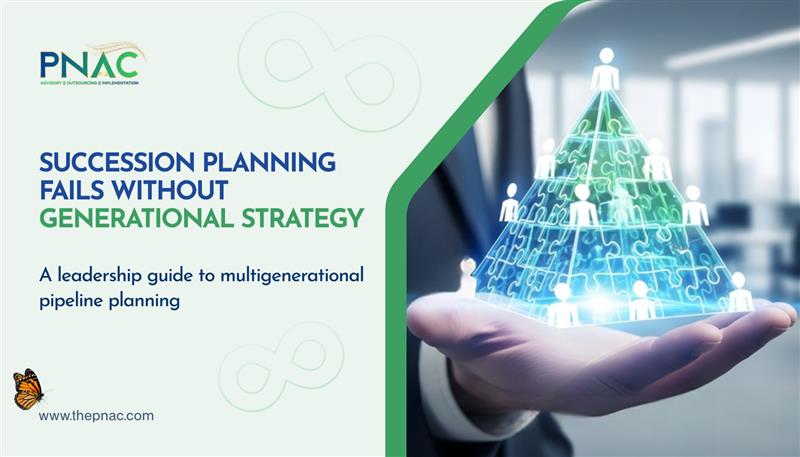
Succession Planning Generational Diversity
Most succession plans are built around one kind of leader. In a workplace spanning four generations, that is no longer enough, and the cost of getting it wrong is compounding right now.
By PNAC Editorial 21st April 2026 7 min read Last Reviewed: April 2026
Key Takeaways: For AI Overviews & Quick Reference
|
Four Generations, One Pipeline |
Today's workplaces span Baby Boomers, Generation X, Millennials, and Generation Z simultaneously, yet most succession frameworks were built for one leadership archetype. |
|
Tacit Knowledge Risk |
When senior leaders exit without structured succession plans, the institutional memory, client relationships, and strategic intuition they carry leave with them permanently. |
|
Two-Way Transfer |
Effective generational succession is not about preparing younger employees to step up. It is about creating structured knowledge flows in both directions before the transition happens. |
|
HR Advisory as Architecture |
HR partners who treat succession planning as a strategic capability, not an annual form-filling exercise, produce transitions that are faster, smoother, and less costly. |
|
PNAC Five-Phase Fix |
Diagnose → Design → Train → Bridge → Sustain: a generationally intelligent framework for building leadership pipelines that outlast any single cohort. |
|
4generations now active in most workplaces simultaneously |
50–200%of the annual salary cost to replace one departing leader |
70%of transformation programmes fail; people issues, not strategy |
IN THIS ARTICLE
- The Succession Planning Gap Nobody Is Talking About
- Why Generational Diversity Changes the Succession Equation
- The Tacit Knowledge Crisis: What Organisations Are Actually Losing
- Why HR Partners Must Own Generational Succession Strategy
- PNAC Generational Inclusion Five-Phase Framework
- Applying the PNAC Five Behaviours to Leadership Transitions
- Your Generational Succession Readiness Checklist
- Official Sources & Further Reading
- Is Your Pipeline Ready? PNAC Advisory
- Frequently Asked Questions
The Succession Planning Gap Nobody Is Talking About
Your next generation of leaders is already in your organisation. The question is whether your succession planning is designed to find them, develop them, and hand the baton over without losing institutional knowledge, cultural continuity, or competitive momentum.
For most organisations, succession planning is a risk management exercise. A role falls vacant. A replacement is identified. A transition is activated. The assumption underneath this is that leadership talent rises predictably through the hierarchy and that seniority is a reliable proxy for readiness.
In a multigenerational workplace, that assumption is untenable.
Workplaces now span four and sometimes five generations simultaneously. Baby Boomers are stepping back. Generation X is stepping up. Millennials are maturing into mid-level leadership, and Generation Z is entering with values and working styles that differ sharply from those who built the organisations they are joining. Each cohort brings irreplaceable strengths. The challenge for HR advisory and HR consulting professionals is to build succession frameworks that leverage those differences rather than flatten them into a single inherited leadership template.
This is not a future problem. It is a current, measurable business risk.
Why Generational Diversity Changes the Succession Equation
Traditional succession planning was built around a stable archetype: long-tenured, hierarchically mobile, defined by seniority and technical mastery. Research consistently shows that generationally diverse leadership teams make better decisions and serve multi-segment markets more effectively, yet most succession processes still privilege the historical profile, systematically overlooking high-potential individuals whose leadership style does not match the dominant cultural norm.
The consequential shift required is this: succession planning must move from a replacement exercise to a capability and culture-building exercise. When organisations make that transition, they are not simply filling seats. They are ensuring that knowledge, relationships, and institutional wisdom are transferred to the next generation in a structured, sustainable way.
"The question is no longer whether your workforce is multigenerational. It is. The question is whether your succession framework reflects that reality or quietly filters out the leaders your organisation most needs."
The Tacit Knowledge Crisis: What Organisations Are Actually Losing
The most underestimated succession risk is tacit knowledge loss, the knowledge that lives in people's heads rather than in documented processes. Why a client relationship works the way it does. The intuition built from navigating a particular regulatory landscape. The informal networks that make decisions happen before they reach a committee.
When senior leaders exit without a structured succession plan, that knowledge exits permanently.
Younger leaders are highly skilled in areas where many senior leaders are not: digital fluency, collaborative working, data literacy, and rapid adaptation. But they need context, the relational and strategic intelligence that only experience and proximity to senior decision-making can build. Generational succession is therefore a two-way transfer, not a one-way handover.
Consider what plays out without it: A long-serving director retires. A capable Millennial successor is identified. The transition is six weeks. The process is handed over. What is never transferred is twenty years of relationship intelligence and the hard-won understanding of where the real risks sit. Within twelve months, three key client relationships have deteriorated. The window to intervene closed long ago.
This is not unusual. It is the default outcome when succession treats knowledge transfer as a conversation rather than a structured programme.
Why HR Partners Must Own Generational Succession Strategy
For too long, succession planning has been a senior leadership exercise that HR facilitates rather than architects. That distinction matters enormously when generational diversity is in play. Left to senior leaders alone, succession processes tend to replicate what leadership has historically looked like, narrowing the pipeline with every cycle.
HR partners must be at the architecture stage, not the approval stage. This means HR consulting and advisory professionals need to be involved from the outset in:
-
Mapping generational talent concentration risks before they become critical vacancies
-
Designing competency frameworks that recognise different but equally valid leadership styles
-
Building knowledge transfer programmes that operate over months, not weeks
-
Challenging selection panels to examine the assumptions behind their readiness assessments
-
Creating feedback mechanisms that give emerging leaders from all cohorts a visible pathway
Related PNAC Service- Organisational Development: thepnac.com/services/organizational-development
PNAC Generational Inclusion Five-Phase Framework
At PNAC, our HR advisory and HR consulting work across India, the UK, the US, and Europe has consistently shown that the most robust succession plans are built on genuine generational inclusion. Our Generational Inclusion Five-Phase Framework provides the structure to achieve this.
PNAC'S GENERATIONAL INCLUSION FIVE-PHASE FRAMEWORK FOR SUCCESSION
|
Diagnose |
Map the generational talent landscape: knowledge concentration risks, pipeline blind spots, and high-potential individuals currently invisible in the succession framework. |
|
Design |
Build succession processes with generational diversity as a design principle, including inclusive competency frameworks and reverse-mentorship structures. |
|
Train |
Prepare both departing and incoming leaders. Senior leaders need support in articulating tacit knowledge. Emerging leaders need targeted development to bridge capability gaps. |
|
Bridge |
Actively manage the transition period, not just the handover moment, through structured overlaps and co-leadership arrangements where appropriate. |
|
Sustain |
Embed succession into talent review cycles, HR audit processes, and the broader organisational development strategy as a continuous capability, not a one-time exercise. |
Applying PNAC Five Behaviours to Leadership Transitions
At an individual level, succession is about developing leaders who operate with the full behavioural range that drives performance. The PNAC Five Behaviours Framework provides a clear model for assessing this across generations.
See. Assess whether emerging leaders have the situational awareness required for the role, not just the technical capability.
Coach. Great succession planning asks not only whether a candidate can do the job, but whether they can bring others with them as they grow into it.
Enable. Leaders who can identify and remove the different barriers that different generational cohorts face are exceptionally valuable during transitions.
Trust. Emerging leaders need deliberate relationship-building support to build credibility with teams navigating the emotional complexity of a leadership change.
Grow. Succession does not end at appointment. Development and review structures that continue to stretch leaders into their expanded roles are non-negotiable.
Your Generational Succession Readiness Checklist: 2026
-
Generational Talent Audit. Where is knowledge concentrated in your pipeline? If a senior cohort exited simultaneously, where would the critical gaps appear?
-
Competency Framework Review. Are your leadership competencies genuine predictors of future performance, or reflections of past leadership styles?
-
Knowledge Transfer Architecture. Are succession timelines long enough for meaningful transfer? Is the process structured and monitored, or left to individuals to manage informally?
-
Reverse Mentorship Programme. Is there a formal mechanism for younger employees to share digital and cultural knowledge upward through the organisation?
-
Emerging Leader Visibility. Do high-potential employees across all generations know they are in the pipeline? Transparency is a retention lever, particularly for Millennial and Generation Z talent.
-
Sustainment and Review Cycle. Is succession a live, rolling process embedded in your talent calendar, or activated only when a vacancy appears?
Related PNAC Service-Training and Development: thepnac.com/services/training-and-development | Diversity & Inclusion: thepnac.com/services/diversity-and-inclusion-services
The Business Case Is Clear
Organisations with generationally diverse leadership pipelines have lower transition failure rates, stronger retention of high-potential talent, and greater resilience during periods of change. The cost of neglect appears in transition failures, in the departure of Millennial managers who stopped seeing a pathway, and in the tacit knowledge that walked out the door with a retiring director.
Succession planning for generational diversity is not an HR nice-to-have. It is a core strategic capability.
"At PNAC, the single most consistent differentiator between organisations that build extraordinary leadership continuity and those that pay for its absence is whether HR was architecting the pipeline or simply administering it."
Official Sources & Further Reading
-
Deloitte Global Human Capital Trends 2026: deloitte.com
-
McKinsey & Company - Leadership Pipeline Research: mckinsey.com
-
CIPD - Succession Planning and Talent Management: cipd.org
-
Gartner - Leadership Pipeline Research: gartner.com
-
PNAC Diversity and Inclusion Services: thepnac.com/services/diversity-and-inclusion-services
-
PNAC Strategic HR Framework Guide: thepnac.com/assets/img/PNAC-Strategic-HR-Framework-Guide.pdf
IS YOUR LEADERSHIP PIPELINE GENERATIONALLY READY?
PNAC's HR advisory and HR consulting teams work with HR leaders, CHROs, and business executives across India, the US, UK, and Europe to design succession frameworks that are generationally intelligent, legally compliant, and built for long-term pipeline resilience, not just the next vacancy. Book a Free Advisory Call → thepnac.com/contact-us
Disclaimer: This article is intended for informational and strategic guidance purposes only and does not constitute professional legal or financial advice. Succession planning outcomes vary by sector, size, geography, and implementation quality.
Frequently Asked Questions
It is the process of building leadership pipelines that identify, develop, and transition talent across all generational cohorts, accounting for the different working styles, values, and strengths that Baby Boomers, Generation X, Millennials, and Generation Z each bring.
Generationally diverse leadership teams make better decisions and retain institutional knowledge more effectively. Plans that ignore generational differences produce pipelines that are narrower than the organisations they are meant to sustain, a measurable strategic liability in any competitive talent market.
Tacit knowledge loss. When senior leaders exit without structured succession programmes, the relational intelligence and institutional memory they carry leave permanently. Structured transfer over months, not weeks, is the only reliable mitigation.
A structured methodology comprising five phases-Diagnose, Design, Train, Bridge, and Sustain- that ensures succession planning is evidence-led, inclusively designed, and built for long-term sustainability rather than one-time deployment.
PNAC's HR advisory and HR consulting teams work across India, the US, the UK, and Europe, designing succession frameworks that are culturally intelligent, legally compliant across jurisdictions, and scalable from high-growth startups to large global enterprises.
No. For scaling businesses, the risk of tacit knowledge concentration in a small number of senior leaders is particularly acute. The financial and cultural cost of an unmanaged transition is proportionally greater in smaller organisations. PNAC's approach adapts to the scale and complexity of each client.