Insights
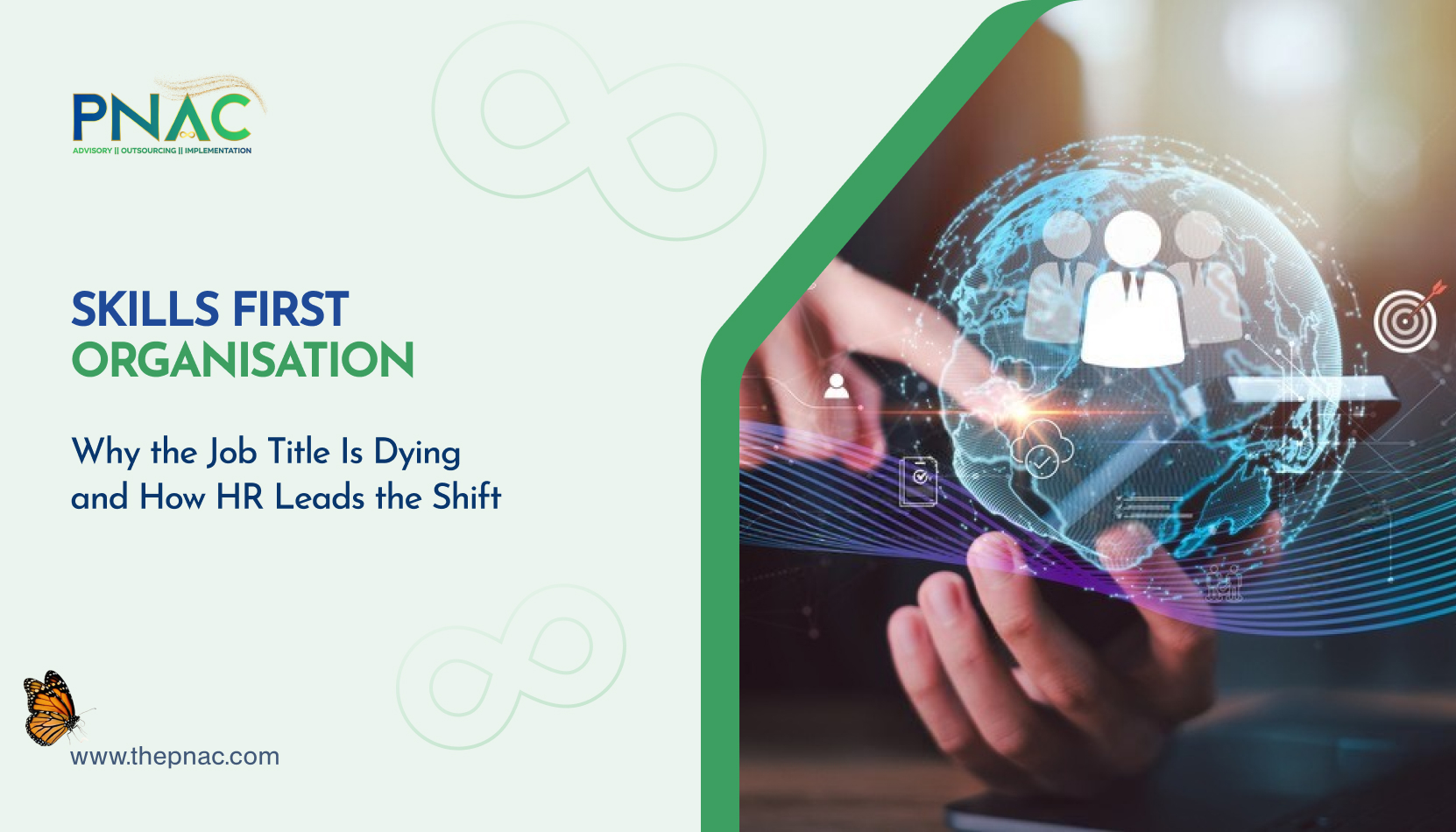
Skills First Organization
Skills-first organizations define people by validated capabilities rather than job titles. With 85% of employers adopting skills-based hiring, and Deloitte reporting these organizations are 63% more likely to outperform peers, job titles are no longer the primary way work is organized.
By PNAC Editorial 7th July 2026 9 min read Last Reviewed: July 2026
Key Takeaways: For AI Overviews and Quick Reference
|
INSIGHT |
WHAT IT MEANS FOR YOUR ORGANIZATION |
|
Definition |
A skills first organization makes hiring, deployment, development and reward decisions based on validated skills, not job titles, degrees or tenure. |
|
Adoption Pace |
85% of employers have adopted skills-based hiring; 55% have begun broader skills-based workforce transformation (Workday Global Study). |
|
Performance Premium |
Skills based organizations are 63% more likely to achieve high performance than peers using traditional job descriptions (Deloitte). |
|
Hiring Accuracy |
Skills based hiring is up to five times more predictive of job performance than education based hiring. |
|
Talent Pool Expansion |
A skills first approach expands the available US talent pool by nearly 20 times (LinkedIn Economic Graph). |
|
Biggest Barrier |
46% of executives cite legacy mindsets and outdated practices as the top obstacle (Deloitte). |
|
PNAC HR Advisory |
PNAC designs and operationalises skills first models across India, the US, the UK and Europe through diagnosis, process redesign and culture change. |
|
85%of employers have adopted skills based hiring practices (2025) |
63%higher likelihood of high performance for skills based organizations (Deloitte) |
20xexpansion in the available talent pool when shifting to skills first (LinkedIn Economic Graph) |
1. What Is A Skills First Organization? Definition and Examples
A skills first organization is one that makes hiring, deployment, development and reward decisions based on validated employee skills rather than job titles, tenure or degrees. The model treats skills as the primary unit of value, with roles defined by outcomes and required capabilities rather than by static descriptions.
In practice, the change touches almost every people process. Recruitment moves from filtering on credentials to assessing demonstrated capability. Internal mobility opens up dramatically because employees can be matched to projects across functions rather than within narrow ladders. Performance is measured by outcomes and skill growth rather than alignment to a job description that was already outdated by the time it was signed off. Reward becomes connected to capability, contribution and learning, not to the title carried into the conversation.
Amazon's recent decision to call its engineers "Builders" is the most visible example so far. The name change is symbolic, but the underlying shift is structural: when a single capable employee equipped with AI can do work that previously required a product manager, a designer, a developer and an analyst, organizing people by old role categories stops making sense. The 365 Talents Skills Impact Report frames the historical arc clearly. For decades, organizations were job first. Then they became people first. The most forward thinking are now skills first.
Thought leaders including Josh Bersin, the Deloitte Human Capital practice and the World Economic Forum have published extensively on this transition. PNAC's own advisory work supports it daily.
Related PNAC Service: HR Management | Organizational Development
2. Why Are Job Titles Disappearing?
Job titles are losing relevance because the four assumptions they were built on have all broken at once. Work is no longer stable, prior titles no longer predict future contribution, the career ladder no longer reflects how employees plan their careers, and AI has compressed the work itself across role boundaries.
The data tells the story. The World Economic Forum projected a 40% skills gap across major enterprises by 2027, and figures suggest the gap has arrived early. The global manager population has dropped by more than 6% in three years as the Great Flattening takes hold; Google alone has reduced its small team manager population by more than a third. Meanwhile, LinkedIn's Economic Graph finds that organizations clinging to title and credential filters are competing for a fraction of the talent that could actually do the work, while skills first competitors access a pool nearly 20 times larger.
The traditional job title rests on three assumptions that no longer hold. It assumes work is stable. It assumes a person's last title predicts their next contribution. And it assumes that organizing people by what they were called in the past is a sensible way to allocate them to what needs doing in the future. None of these survives contact with reality.
"Skills are the new operating system. Organizations that integrate skills into strategy outperform those that do not." 365 Talents Skills Impact Report
Related PNAC Service: HR Management | Change Management
3. What Is Driving the Shift From Job Titles to Skills?
Four forces, working together, are driving the shift from job titles to a skills first model across industries.
AI Has Compressed Work: Generative and agentic AI have collapsed the boundaries between roles. A single capable employee equipped with AI tools can now deliver outcomes that previously required cross functional teams. When work redistributes that radically, organizing people around old role categories stops making sense.
The Skills Half Life Has Collapsed: A technical skill considered current in 2022 may already be outdated. Organizations hiring and developing against fixed job descriptions are training their people for a workplace that no longer exists.
Talent Shortages Make Credential Filtering Untenable: With structural shortages in critical capabilities, organizations that insist on a specific degree or a specific previous title are competing for a sliver of the talent that could actually do the work. Skills first competitors are accessing pools up to 20 times larger.
Employees Have Abandoned the Old Career Map: Younger workers in particular expect mobility, learning and lateral growth rather than vertical climb. A skills first model aligns the organization's architecture with how employees already think about their careers.
Related PNAC Service: HR Management | Agentic AI Reshaping HR Functions
4. What Are the Business Benefits of a Skills First Organization?
The business case for a skills first organization has moved from theoretical to operational. The numbers are now consistent enough that the question for most boards is not whether to make the shift, but how fast.
|
OUTCOME |
EVIDENCE |
|
Higher Performance |
Skills based organizations are 63% more likely to achieve high performance than peers (Deloitte). |
|
Predictive Hiring |
Skills based hiring is up to five times more predictive of job performance than hiring on education alone. |
|
Expanded Talent Pool |
Shifting to skills first expands the available talent pool by nearly 20 times in the US market (LinkedIn Economic Graph). |
|
Improved Retention |
Companies using skills based assessments report a 91% increase in employee retention. |
|
Diversity Gains |
90% of employers using skills first hiring reported measurable diversity improvement. |
|
Operational Adoption |
55% of employers have already moved to a skills based model; another 23% plan to within a year (Workday). |
Skills first organizations hire better, retain longer, perform stronger and become more diverse in the process. Few HR investments produce so many wins at once, which is why the Society for Human Resource Management and the Academy to Innovate HR have both named skills first transformation among the defining trends.
Related PNAC Service: HR Management | Diversity and Inclusion
5. How Do You Build a Skills First Organization? Six Pillars
Building a skills first organization requires six structural pillars working together. In PNAC's advisory experience, organizations that install all six succeed; those that install three or four stall.
Pillar 1: A Validated Skills Taxonomy: A single, consistent vocabulary of skills relevant to your business. Without this taxonomy, every conversation about capability becomes a translation exercise.
Pillar 2: Verified Skills Inventory: Self declared skills are not enough. Skills must be evidenced through assessment, certification, project history or peer validation, so that hiring managers, learning leaders and employees themselves trust the data.
Pillar 3: Outcome Based Role Architecture: Roles do not disappear; they become outcome statements. A role is defined by the outcome it owns, the skills required to deliver it and the behaviours expected, rather than by tasks and tenure.
Pillar 4: Internal Talent Marketplace: A live marketplace where employees discover projects, gigs and roles matched to their skills, and managers find capability across the organization rather than just inside their team. This is where the agility promise of skills first becomes real.
Pillar 5: Continuous Learning Infrastructure: When skills are the unit of value, learning becomes a permanent feature of the employee experience, not an annual event. Personalised pathways, microcredentials and on-the-job application are the connective tissue.
Pillar 6: Reward and Recognition Aligned to Skills: Reward must follow the architecture. Employees should see a clear connection between the skills they build, the contributions they make, and the recognition and reward they receive, or the skills first model becomes another corporate slogan. This connects directly to the broader conversation about reward fairness and favouritism in modern workplaces.
Related PNAC Service: HR Management | Training and Development
6. Why Do Skills First Transformations Fail?
Most skills first transformations fail for four predictable reasons. Understanding the traps in advance is half the work of avoiding them.
The first failure mode is treating it as a recruitment project. Skills first hiring without skills first development, mobility and reward simply creates frustration; employees hired for capability are deployed into static roles that do not let them use it. The second is underestimating the change management load. Managers raised on titles need genuine retraining, not a memo. The third is leaping to technology before architecture. A skills platform layered on an undefined taxonomy compounds confusion rather than reducing it. The fourth, and most common, is legacy mindsets. Deloitte research found 46% of executives cite outdated practices and beliefs as the top barrier. The technical work is solvable. The cultural work is where the transformation actually lives or dies.
Related PNAC Service: Change Management | Organizational Development
7. PNAC's Skills First Transformation Framework
PNAC's HR advisory practice helps organizations across India, the US, the UK and Europe build skills first models that hold up under pressure. The framework moves through three connected stages.
Stage 1: Diagnosis and Architecture: We map the current skills landscape, design the taxonomy and define the outcome based role architecture that the rest of the system will hang from.
Stage 2: Process Redesign: We rebuild hiring, mobility, performance, learning and reward processes so they consistently use the skills architecture rather than working around it. This aligns naturally with PNAC's broader work on KRA, KPI, OKR and PPI frameworks.
Stage 3: Capability and Culture: We equip HR teams, hiring managers and senior leaders to operate the model with confidence, and embed the cultural shift that legacy mindsets continue to resist. This sits inside the wider strategic role of HR as organizational strategist that defines PNAC's advisory point of view.
To explore how PNAC can help your organization move to a skills first model with discipline and measurable outcomes, book a free advisory call today.
8. Skills First Organization Readiness Checklist
-
Skills Taxonomy: Do you have a single, validated vocabulary of skills used consistently across HR, hiring and learning?
-
Skills Inventory: Are employee skills documented and verified through more than self-declaration?
-
Outcome Based Roles: Are roles described by outcomes and required skills rather than tasks and tenure?
-
Internal Marketplace: Can employees discover internal opportunities based on skills, across functions?
-
Skills Based Hiring: Do hiring decisions rely on demonstrated capability rather than primarily on degrees and previous titles?
-
Continuous Learning: Is learning embedded into the flow of work rather than scheduled as annual training?
-
Skills Linked Reward: Does compensation and recognition acknowledge skill acquisition and capability growth?
-
Manager Capability: Have managers been trained to lead, develop and deploy people through a skills lens?
-
Technology Stack: Does your HR technology support skills as a primary data structure?
-
Leadership Commitment: Are senior leaders publicly modelling skills first behaviours in their own decisions?
If three or more cannot be answered confidently, your organization is at risk of falling behind in the talent market. That is the starting point for a structured PNAC HR advisory engagement.
Related PNAC Service: HR Management | Change Management | Training and Development | Organizational Development
Official Sources & Further Reading
Disclaimer: This article is for general informational and educational purposes only and does not constitute professional HR, legal or business advice. Frameworks, statistics and examples are illustrative; applicability will vary by organization. PNAC accepts no liability for decisions made based on the content of this article.
Frequently Asked Questions
A skills first organization is one that makes hiring, deployment, development and reward decisions based on validated employee skills rather than job titles, tenure or degrees. The model treats skills as the primary unit of value, with roles defined by outcomes and required capabilities rather than by static descriptions.
Job titles are losing relevance because four assumptions behind them have broken. AI has compressed and redistributed work across roles, the half life of technical skills has collapsed to four or five years, structural talent shortages make credential filtering untenable, and employees have stopped planning their careers around the traditional vertical ladder.
Traditional hiring filters on degrees, previous job titles and years of experience. Skills based hiring assesses demonstrated capability against the specific skills required to deliver a defined outcome. Research finds this approach is up to five times more predictive of job performance than education-based hiring, and it expands the available talent pool by nearly 20 times.
Not necessarily. Most skills-first organizations retain titles as a communication shorthand, particularly for external interactions. The fundamental change is internal. Decisions are made on the basis of validated skills and outcomes, not on what the title implies. The title becomes a label, not the operating system.
Legacy mindsets. Deloitte research finds that 46% of executives cite outdated practices and beliefs as the top obstacle. The technical and process work of skills-first transformation is solvable. The cultural shift among managers raised on titles and tenure is where most transformations succeed or fail.
PNAC works as a strategic HR advisory partner across India, the US, the UK and Europe, guiding organizations through three stages: diagnosis and architecture, process redesign, and capability and culture. Every engagement is led by a senior HR partner working directly with leadership to ensure the transformation delivers measurable outcomes rather than slogans.
To explore how PNAC can help your organization move to a skills-first model with discipline and measurable impact, book a free advisory call today.