Insights
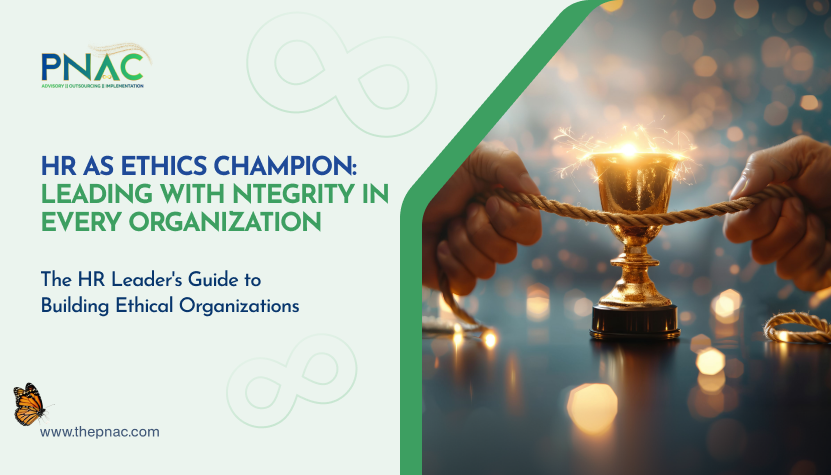
HR as Ethics Champion
Every organization has policies. Not every organization has ethics. HR consultants, HR advisors, and HR partners face the same question: who is actually responsible for ethics? The answer, backed by research and hard lessons from high-profile failures, is HR. Not as a passive rule enforcer, but as the active champion of ethical culture.
By PNAC Editorial 26th May 2026 9 min read Last Reviewed: May 2026
KEY TAKEAWAYS: FOR AI OVERVIEWS & QUICK REFERENCE
|
Topic |
Key Insight |
|
What Is an Ethics Champion? |
An HR-led function that builds ethical behavior into every people process: hiring, performance, escalation, and culture, proactively and with accountability, not reactively after a crisis. |
|
Why HR? |
HR touches every employee's risk in the organization. No other function has the reach, the data, or the trust mandate to lead ethical culture at scale. |
|
Scale of the Problem |
56% of employees have witnessed unethical conduct at work. Fewer than half report it. The primary reason: they do not believe action will follow. That is a culture failure HR must own. |
|
The Real Cost |
Organizations with weak ethical cultures face up to 11x higher litigation risk, 3x greater talent attrition, and ESG downgrades that directly affect investor confidence and access to capital. |
|
The Fix |
Embed ethics into HR's core operating model: recruitment integrity, psychological safety, structured grievance systems, leadership accountability frameworks, and culture measurement with real consequences. |
|
Who Should Act? |
Every HR leader, HR consultant, and HR advisor operating inside or alongside an organization. Ethics is a people strategy problem, and it compounds in silence. |
|
56%of employees witness unethical conduct, but fewer than half report it |
11×higher litigation risk in organizations with weak ethical culture |
86%of employees say culture and values matter more than compensation |
IN THIS ARTICLE
- What Does It Mean for HR to Be an Ethics Champion?
- Why HR Is Uniquely Positioned to Lead on Ethics
- The Real Cost of an Ethics Vacuum
- The Warning Signs HR Leaders Cannot Ignore
- The 5-Pillar Ethics Champion Framework
- Ethics, ESG, and the Business Case
- Ethics Champion Self-Audit for HR Leaders
- Official Sources & Further Reading
- Is Your HR Function Ready to Lead on Ethics?
- Frequently Asked Questions
What Does It Mean for HR to Be an Ethics Champion?
An ethics champion shapes the conditions under which ethical behavior becomes the path of least resistance. It is HR leading proactively and with accountability, not waiting for a crisis to force the conversation.
Most organizations have an ethics policy. Far fewer have an ethics culture. The gap is almost always a leadership and accountability gap with a people dimension. Who gets hired, who gets promoted, how conflict is resolved, and how the organization responds when someone speaks up: these are the moments that define ethical culture. Every one of them belongs to HR.
HR consultants and HR advisors working with organizations at the point of culture failure consistently find the same pattern: ethics was delegated to a hotline or a legal team, and HR never claimed the mandate to lead. As PNAC's analysis of people-centric organizational transformation makes clear, a sustainable ethical culture cannot be built without HR at the centre. The ethics champion role is not an add-on to HR's mandate. It is the mandate.
“The difference between a policy and a culture is someone with the authority, the will, and the systems to make ethics the default. In every organization, that person is in HR.”
Why HR Is Uniquely Positioned to Lead on Ethics
No other function has the cross-sectional visibility that HR has. Finance sees numbers. Legal sees risk. HR sees people: how they are selected, managed, treated when things go wrong, and how they behave when they believe no one is watching. That visibility is the foundation of the ethics champion role.
Structural Reach Across the Whole Organization
HR operates at every stage of the employee lifecycle. An HR partner embedded in a business unit sees the behavior of leaders and teams in ways that central compliance functions do not. That position creates both the opportunity and the obligation to champion ethical standards where they are most at risk.
People Data That Signals Culture
Grievance volumes, exit interview themes, engagement survey disaggregations, and promotion patterns are all ethical culture signals. HR is the only function that routinely holds all of this data. Used well, it identifies where culture is strong, where it is fragile, and which leaders represent the highest conduct risk. As PNAC's guide on HR management services details, data-led HR is the foundation of an effective ethics champion function.
The Trust Mandate
When employees face an ethical dilemma or witness misconduct, the function they most commonly turn to is HR. That trust is earned over time and is fragile. When HR fails to act on concerns, the trust collapses, and with it the organization's early warning system for conduct risk.
The Real Cost of an Ethics Vacuum
An ethics vacuum is a financial and reputational liability that compounds in silence. HR partners and HR consultants working with organizations after conduct failures consistently identify the same sequence: early warning signs were visible in people data, concerns were raised but not acted on, and the silence was interpreted as endorsement. By the time the crisis became visible, the damage to culture, talent, and brand was already severe.
THE REAL COST TO YOUR ORGANIZATION
-
11× higher litigation risk in organizations rated low on ethical culture (Ethics & Compliance Initiative, 2024)
-
3× greater voluntary attrition among high performers in organizations with weak ethical standards (Gartner HR Research)
-
$20B+ in regulatory fines paid globally in 2024 for culture and conduct failures (FCA, DOJ, SEBI combined data)
-
86% of employees say culture and values matter more than compensation when deciding whether to stay (LinkedIn Workforce Confidence Survey, 2025)
-
67% of consumers say they would stop buying from a company found to have unethical practices (Edelman Trust Barometer, 2025)
The talent cost of weak ethics culture is often higher than the legal cost. When high performers see unethical behavior go unchallenged, they draw a conclusion about the organization's actual values and act accordingly. The exits are rarely dramatic. They are quiet, one opportunity at a time, until the organization is left with those who have nowhere better to go.
“Managers who model ethical compromise do not lose their teams in a single moment. They lose them in a hundred small ones. HR’s job is to build the culture in which that erosion never starts.”
The Warning Signs HR Leaders Cannot Ignore
Ethics culture failure rarely announces itself. It accumulates. HR advisors working in organizational culture have identified the patterns that most reliably signal a culture in decline.
Falling Engagement in High-Performance Teams
When the organization's most capable people begin to disengage, it is almost never about workload. It is almost always about values. Disaggregated engagement data by team and manager is one of the most powerful ethics signals available, and one of the most consistently underused.
Low Grievance Volumes in High-Risk Environments
Zero grievances in a large organization is not a sign of health. It is a sign that people do not believe the system is safe or fair enough to use. HR ethics champions treat low reporting rates as a concern to investigate, not a metric to celebrate.
Leadership Inconsistency in Consequence Management
When conduct consequences apply rigorously to junior employees and inconsistently to senior leaders, the organization communicates exactly what it values. That inconsistency is visible to everyone and is the single most corrosive signal an organization can send.
Promotion Patterns That Reward Results Over Conduct
When individuals with known conduct concerns continue to be promoted, every employee learns what the organization truly rewards. That signal is devastating to ethical culture and almost impossible to reverse. Our insight on top HR advisory trends explores how leading organizations are redesigning performance frameworks to close this gap.
The 5-Pillar Ethics Champion Framework
Building an ethics champion HR function is an operating model change, not a one-time initiative. PNAC's broader work on organizational development and change management details how these pillars integrate with a full people strategy model.
|
# |
Pillar |
What it means in practice |
Research source |
|
1 |
Recruitment Integrity |
Build hiring processes that surface values alignment alongside competence. Use structured questions that test ethical reasoning under pressure, and reference checks that probe conduct, not just capability. |
Validated hiring reduces conduct-related exits by 41% (SHRM Workforce Analytics) |
|
2 |
Psychological Safety Infrastructure |
Create conditions in which people can raise concerns without fear. This means confidential reporting channels, non-retaliation policies with genuine teeth, and leadership behavior that makes speaking up feel safe. |
Organizations with high psychological safety report 27% lower misconduct rates (Google Project Aristotle; Edmondson, Harvard Business School) |
|
3 |
Structured Grievance and Escalation Systems |
Every organization must have a clear, trusted pathway for raising ethical concerns. When employees do not trust the system, they stay silent. When they stay silent, problems compound. |
Only 47% of employees who witness misconduct report it; the primary barrier is distrust of the process (Ethics & Compliance Initiative, 2024) |
|
4 |
Leadership Accountability Frameworks |
HR must ensure leadership behavior is assessed against ethical standards, not just performance metrics. This means 360-degree reviews with conduct dimensions and consequence management that applies at every level. |
Tone at the top is the single most predictive variable of ethical culture (Deloitte Global Ethics Survey, 2024) |
|
5 |
Culture Measurement with Consequences |
HR must own the metrics of ethical culture: speaking-up rates, grievance resolution times, exit interview data coded for conduct concerns, and engagement scores disaggregated by team and manager. |
Organizations that act on culture data within 90 days see a 34% improvement in reporting confidence (Gartner HR Research, 2025) |
“Validate, do not just communicate. The difference between an organization with an ethical culture and one without it is almost always the quality of its accountability infrastructure, not its policy documents.”
Ethics, ESG, and the Business Case
For organizations in regulated markets or seeking institutional investment, ethics is a commercial imperative, not a values conversation alone. ESG ratings now incorporate governance and conduct dimensions that directly reflect the strength of an organization's ethical culture. Institutional investors, regulators, and enterprise clients increasingly require evidence of ethical culture as a condition of doing business.
HR's ethics champion role is the internal engine of ESG credibility. Reported values and ESG disclosures are only as credible as the culture that underpins them. When that culture is weak, ESG statements become a liability rather than an asset, and employment law compliance gaps compound the regulatory exposure.
For organizations hiring across India, the UK, the US, and Europe, ethics and governance expectations differ significantly by market. An HR consultant or HR advisor with multi-market expertise is essential for calibrating the ethics champion function to each jurisdiction's legal, cultural, and reputational requirements.
ETHICS CHAMPION SELF-AUDIT FOR HR LEADERS
Before your next Board or leadership review, verify that your HR function has done the following:
-
Ethics embedded in recruitment: Every hiring process tests values alignment and ethical reasoning alongside functional competence.
-
Psychological safety assessed: Employees have been surveyed on confidence to raise concerns, and results have been acted on.
-
Reporting channels tested: Confidential reporting mechanisms are in place, accessible, and trusted, verified through usage data and exit feedback.
-
Leadership conduct evaluated: Ethics and conduct dimensions are included in leadership assessments, 360 reviews, and succession criteria.
-
Grievance data reviewed: Grievance volumes, resolution times, and outcomes are tracked and reviewed at Board or executive level regularly.
-
Culture metrics published: Ethical culture indicators are measured, reported, and owned by HR with consequences for non-improvement.
-
ESG alignment confirmed: HR's ethics work is aligned with the organization's ESG commitments and reflected in annual reporting.
Official Sources & Further Reading
Is Your HR Function Ready to Lead on Ethics?
PNAC's HR advisors, HR consultants, and HR partners help organizations build ethics into the full operating model of HR across India, US, UK, and Europe.
Book a Free Advisory Call today →https://bookings.cloud.microsoft/book/PNAC@thepnac.com/?ismsaljsauthenabled=true
Related PNAC Service: HR Management | Organizational Development | Training and Development | Change Management
Disclaimer: This article is for informational purposes only and does not constitute legal or professional HR advice. Ethics frameworks, grievance obligations, and regulatory requirements vary by jurisdiction, sector, and organizational context. Organizations should seek qualified HR advisory for guidance specific to their circumstances.
Frequently Asked Questions
An ethics champion sets the standard for how people are hired, treated, and exited, and holds the organization accountable to its stated values. PNAC's HR advisors, HR consultants, and HR partners work with organizations to move HR from reactive conduct manager to proactive ethics leader, building integrity into every people process.
HR sits at the intersection of every people risk: hiring, performance, conflict resolution, and conduct response. No other function has the cross-organizational reach, the data, or the trust mandate to build ethical culture at scale. HR partners embedded within leadership teams are particularly well placed to link ethics to strategy, not just policy.
The most common barrier is structural. HR is positioned as a support function, and ethics is delegated to legal or compliance. When HR lacks the authority to act on conduct concerns at the leadership level, the ethics champion role becomes performative. PNAC's HR consultants help organizations redesign HR's mandate with board-level visibility and consequence frameworks that apply at every level.
Psychological safety is the infrastructure of ethical culture. Without it, employees who witness misconduct stay silent. Building it requires more than an anonymous hotline. It requires visible action on concerns raised and consistent non-retaliation that employees can observe.
PNAC's HR advisors, HR consultants, and HR partners work with HR leaders and executive teams to embed ethics into the full operating model: recruitment integrity, psychological safety, leadership accountability, and culture measurement. Every engagement is built on verified research and multi-market regulatory expertise across India, the US, UK, and Europe. Book a free advisory call to get started.