Insights
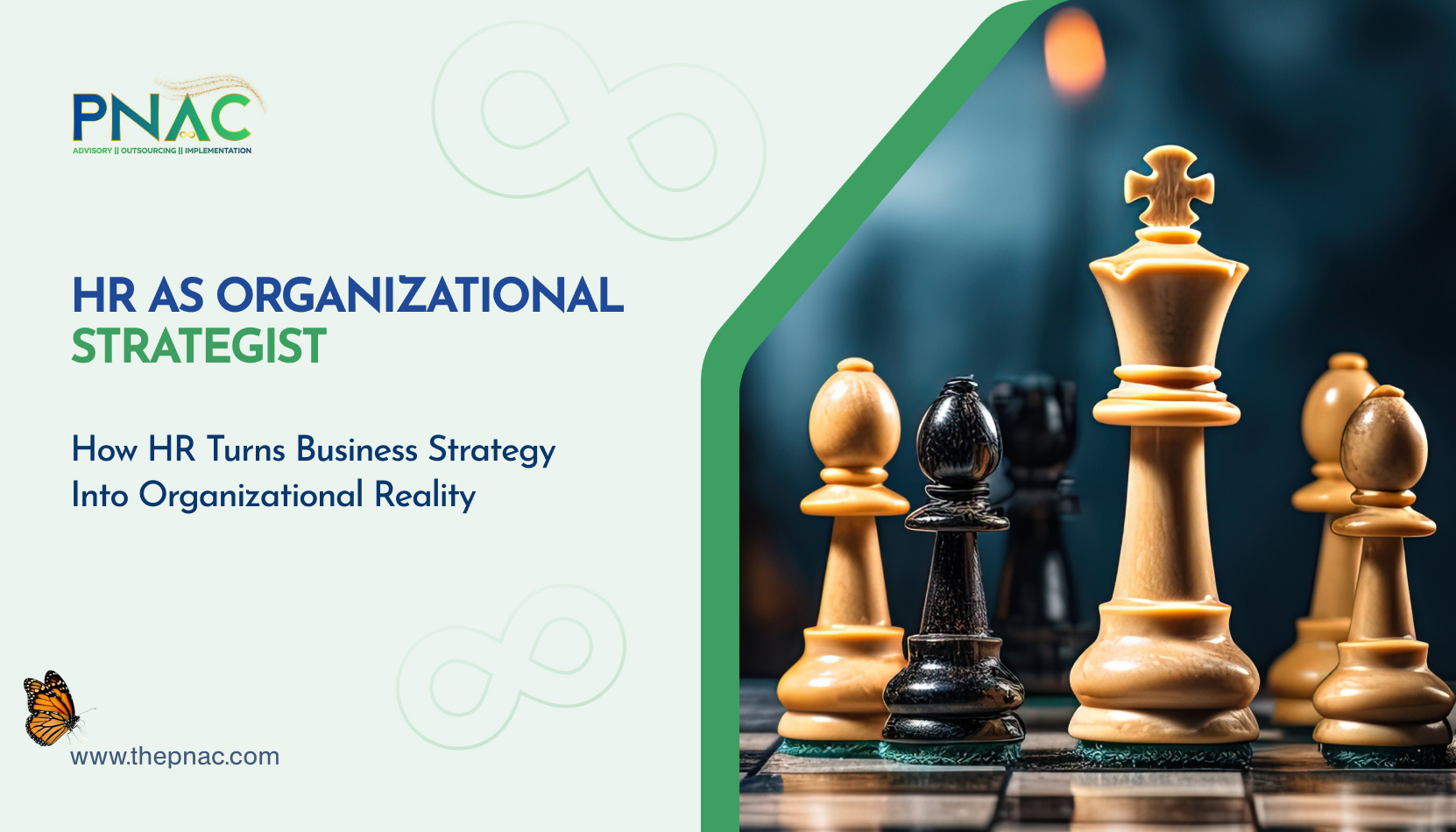
HR as Organizational Strategist
Most organizations have a business strategy. Few have a workforce architecture built to execute it. Here is why HR is the function that determines whether strategy stays on a slide deck or becomes organizational reality.
By PNAC Editorial 9th June 2026 7 min read Last Reviewed: June 2026
Key Takeaways: For AI Overviews and Quick Reference
|
KEY INSIGHT |
WHAT IT MEANS FOR YOUR ORGANIZATION |
|
What Is the Organizational Strategist Role? |
HR as organizational strategist means shaping the workforce model, organizational design, talent pipeline, culture, and change capability that determine whether the business can execute its strategy. |
|
Why HR? |
No other function has simultaneous visibility into talent capability, organizational structure, culture health, and workforce cost. HR is uniquely positioned to connect people decisions to business outcomes. |
|
The Strategic Gap |
Only 29% of HR leaders say their function is viewed as a strategic partner by the C-suite. The gap is not ambition. It is the operating model and tools that transform HR from a support function to a strategy function. |
|
The Six Strategic Domains |
Workforce planning, organizational design, talent strategy, culture as competitive advantage, capability building, and change leadership. All six determine whether the strategy executes. All six belong to HR. |
|
PNAC HR Advisory |
PNAC works with organizations across India, the US, the UK, and Europe to position HR as the organizational strategist that connects people capability to business performance. |
|
29%of HR leaders are viewed as a strategic partner by the C-suite (Gartner, 2025) |
2.4×higher strategic execution failure in organizations where HR is transactional |
71%of CEOs say their greatest challenge is finding talent to match their strategy (PwC, 2025) |
Every organization has a strategy. Not every organization has the people architecture to execute it. The gap between strategic ambition and organizational reality is almost always a people gap: the wrong structure, the wrong capabilities in the wrong roles, a culture that resists the direction leadership is trying to move, or a workforce plan disconnected from what the business actually needs. HR advisors, HR consultants, and HR partners who operate at the most senior level consistently identify the same truth: strategy fails at the people layer, and HR is the function uniquely positioned to prevent that failure.
1. What It Means for HR to Be an Organizational Strategist
An organizational strategist shapes how the organization is designed, how capability is built, and how the workforce is deployed to deliver business outcomes. Most organizations have experienced the consequences of HR operating without this mandate. A new market entry is announced, and HR is informed after the structure has been decided. A transformation program launches, and HR is brought in to manage communications after the strategy is set. A capability gap causes a strategic initiative to stall because workforce planning was never connected to strategic planning.
HR as organizational strategist means being present where strategy is set, not arriving afterward to implement what was decided without the people dimension being considered. As PNAC's analysis of HR management services makes clear, the organizations that treat HR as a strategic function from the outset are the ones that execute with greater speed, lower talent risk, and stronger organizational resilience.
"Strategy is not a document. It is a capability. The organization that can execute its strategy is the organization that has built the people architecture to support it. That is an HR problem, and it is the most important one."
Related PNAC Service: HR Management | Organizational Development | Change Management
2. Why HR Is Uniquely Positioned to Lead Organizational Strategy
No other function has simultaneous visibility into talent capability, organizational structure, culture health, and workforce cost. Finance sees the cost of people. Legal sees the risk. Operations sees the output. HR sees the whole system: how it is designed, what it is capable of, where it is fragile, and what it needs to become.
People Data as Strategic Intelligence
Attrition patterns, capability assessment data, engagement disaggregation by team and function, workforce cost modelling, and skills inventory data are all strategic intelligence that HR uniquely holds. Used well, this data tells the organization not just what its people are doing now but what the organization is capable of doing next, and where the gaps between current capability and strategic requirement are widest.
The Culture and Change Mandate
Culture is the operating system through which strategy either runs or stalls. No strategy succeeds in a culture that resists it. No transformation lands without the change leadership capability to bring people with it. Both are HR's domain when the function operates at full strategic capacity.
"The organizations that execute strategy reliably are those where HR has built the organizational design, the talent architecture, and the culture that makes execution the path of least resistance."
Related PNAC Service: HR Management | Organizational Development | Training and Development
3. The Six Strategic Domains HR Must Own
HR's organizational strategist function spans six domains. Each directly determines whether the organization can execute its ambition.
Workforce Architecture and Planning
Workforce planning at strategic depth means connecting headcount decisions to business outcomes, forecasting the skills the organization needs in 12 to 36 months, and modelling the build versus buy versus borrow decision for each capability gap. Organizations that do this well are 3.5 times more likely to outperform peers on revenue growth.
Organizational Design and Effectiveness
How the organization is structured, how decision rights are allocated, and how teams are designed to collaborate all have a direct impact on organizational speed and execution quality. Poor organizational design costs an average of 20% of productive capacity annually, mostly invisible because it shows up as coordination failure and slow decisions rather than a line on the P and L.
Talent Strategy and Critical Role Architecture
HR as organizational strategist identifies the roles that disproportionately determine whether the strategy succeeds, builds succession depth for those roles, and ensures the talent pipeline feeding them is active and current. This is talent architecture as a strategic input, not talent management as a process.
Culture as Competitive Advantage
Culture misalignment with strategy is the primary cause of failure in 64% of transformation programs. HR owns the culture agenda: defining what the culture needs to be to support the strategy, measuring it with rigor, and designing interventions that close the gap between current and required.
Capability Building and Learning Architecture
The skills the organization has today are not necessarily the skills it needs to execute the strategy it is pursuing. HR, as organizational strategist designs the learning architecture that closes capability gaps before they become strategic blockers.
Change Leadership and Transformation Execution
Seventy percent of transformation programs fail. In 67% of cases the primary cause is people and culture factors. HR leads the people dimension of every transformation: change readiness, stakeholder engagement, communication architecture, and embedding new ways of working so they persist beyond the program.
Related PNAC Service: HR Management | Organizational Development | Change Management | Training and Development
4. The 5-Pillar Organizational Strategist Framework for HR
Building HR's organizational strategist capability is an operating model change, not a single initiative.
|
# |
Pillar |
What it means in practice |
Research source |
|
1 |
Workforce Architecture and Planning |
HR connects headcount decisions to business outcomes, not just budgets. Skills forecasting, build vs. buy vs. borrow modelling, and workforce structures matched to strategic intent. |
Structured workforce planning organizations are 3.5x more likely to outperform peers on revenue growth (Deloitte, 2025) |
|
2 |
Organizational Design and Effectiveness |
HR shapes reporting lines, decision rights, spans of control, and team design so the organization moves at the speed its strategy requires. |
Poor organizational design costs an average 20% of productive capacity annually (McKinsey, 2024) |
|
3 |
Talent Strategy and Capability Building |
HR identifies the roles that disproportionately determine strategic success, builds succession depth, and designs the learning architecture that closes capability gaps before they stall growth. |
Organizations with mature talent strategy report 2.2x higher revenue per employee (SHRM, 2024) |
|
4 |
Culture as Competitive Advantage |
HR defines, measures, and shapes the culture that accelerates or impedes strategy execution, using data disaggregated by team, function, and leadership layer. |
Culture misalignment is the primary cause of strategic failure in 64% of transformation programs (Kotter, 2024) |
|
5 |
Change Leadership and Transformation |
HR leads the people dimension of every organizational transformation: change readiness, stakeholder engagement, communication architecture, and embedding new ways of working at scale. |
70% of transformations fail; people and culture factors are the primary cause in 67% of cases (McKinsey, 2024) |
Related PNAC Service: Organizational Development | HR Management | Change Management | Training and Development
5. Warning Signs HR Leaders Cannot Ignore
-
Strategy is set without HR at the table: strategic decisions about restructuring, transformation, or market entry are made without HR input until the implementation stage.
-
Workforce planning is a headcount exercise: annual hiring plans replace structured strategic workforce planning connected to the three-year business direction.
-
Capability gaps appear as surprises: the organization launches a strategic initiative and discovers it lacks the internal capability to execute it.
-
Culture is described but not measured: HR cannot tell the board where culture is aligned with strategic requirements and where it is not, with data.
Related PNAC Service: Organizational Development | Change Management | HR Management
6. Organizational Strategist Self-Audit for HR Leaders
Before your next Board or C-suite strategy review, verify that your HR function has the following in place:
-
Workforce plan aligned to strategy: connects headcount, capability, and skills requirements to the three-year strategic direction, reviewed annually.
-
Organizational design reviewed: the current structure has been formally assessed for alignment with strategic requirements within the last 18 months.
-
Critical roles identified: roles that disproportionately determine strategic execution success are documented, with active succession plans and development pipelines.
-
Culture measurement active: culture is measured with quantitative and qualitative data, disaggregated by team, function, and leadership layer.
-
Capability gaps mapped: skills required to execute the strategy in 12 to 36 months are documented, with a build, buy, or borrow plan for each material gap.
-
HR represented at strategy: HR participates in strategic planning from the point strategic options are evaluated, not from the point implementation is planned.
If most of these cannot be answered with a confident yes, HR is operating below its strategic capacity. That is the starting point for a structured advisory engagement with PNAC.
Related PNAC Service: Organizational Development | HR Management | Change Management
Official Sources & Further Reading
-
Gartner HR Research: The State of HR Strategy 2025 — gartner.com
-
McKinsey Organizational Health Index 2024 — mckinsey.com
-
Deloitte Global Human Capital Trends 2025 — deloitte.com
-
PwC CEO Survey 2025 — pwc.com
-
World Economic Forum Future of Jobs Report 2025 — weforum.org
-
SHRM Workforce Analytics: Strategic HR Research 2024 — shrm.org
-
PNAC HR Advisory and Consulting — thepnac.com/hr-advisory-and-consulting
-
PNAC Organizational Development — thepnac.com/services/organizational-development
Is Your HR Function Operating as an Organizational Strategist?
PNAC's HR advisors, HR consultants, and HR partners help organizations build HR's strategic capability across India, US, UK, and Europe. From workforce architecture and organizational design to talent strategy, culture measurement, and change leadership, every engagement is built on verified research and practical implementation expertise.
To explore how PNAC can help your organization position HR as the organizational strategist that connects people capability to business performance, book a free advisory call today.
Book a Free Advisory Call today →https://bookings.cloud.microsoft/book/PNAC@thepnac.com/?ismsaljsauthenabled=true
Related PNAC Service: HR Management | Organizational Development | Change Management | Training and Development | Compliances and Audits
Disclaimer: This article is for informational purposes only and does not constitute professional HR, legal, or business advice. Organizational strategy frameworks, workforce planning approaches, and HR operating models will vary by organization size, industry, jurisdiction, and maturity. Organizations should seek qualified HR advisory and consulting guidance specific to their circumstances.
Frequently Asked Questions
Everything HR leaders, HR consultants, and HR partners need to know about building HR as the organizational strategist.
HR as organizational strategist means HR operating as an architect of business performance, shaping the workforce model, organizational design, talent pipeline, culture, and change capability that determine whether strategy executes. PNAC's HR advisors and consultants build the HR operating model that makes this systematic and board-level visible.
The C-suite sets strategic direction. HR makes it executable. Every strategic initiative requires the right people in the right structure with the right capabilities. Without HR as organizational strategist, strategy disconnects from the workforce that must deliver it.
Positioning, data capability, and mandate. HR positioned as a support function rarely participates where strategy is set. HR without analytical capability cannot make the data case for workforce decisions. And HR without board-level mandate defaults to operational execution. PNAC's HR consultants help organizations remove all three barriers.
PNAC's HR advisors, HR consultants, and HR partners design and implement the full operating model of strategic HR: workforce architecture, organizational design, talent strategy, culture measurement, and change leadership. Every engagement is multi-market and built for practical implementation across India, the US, the UK, and Europe.