Insights
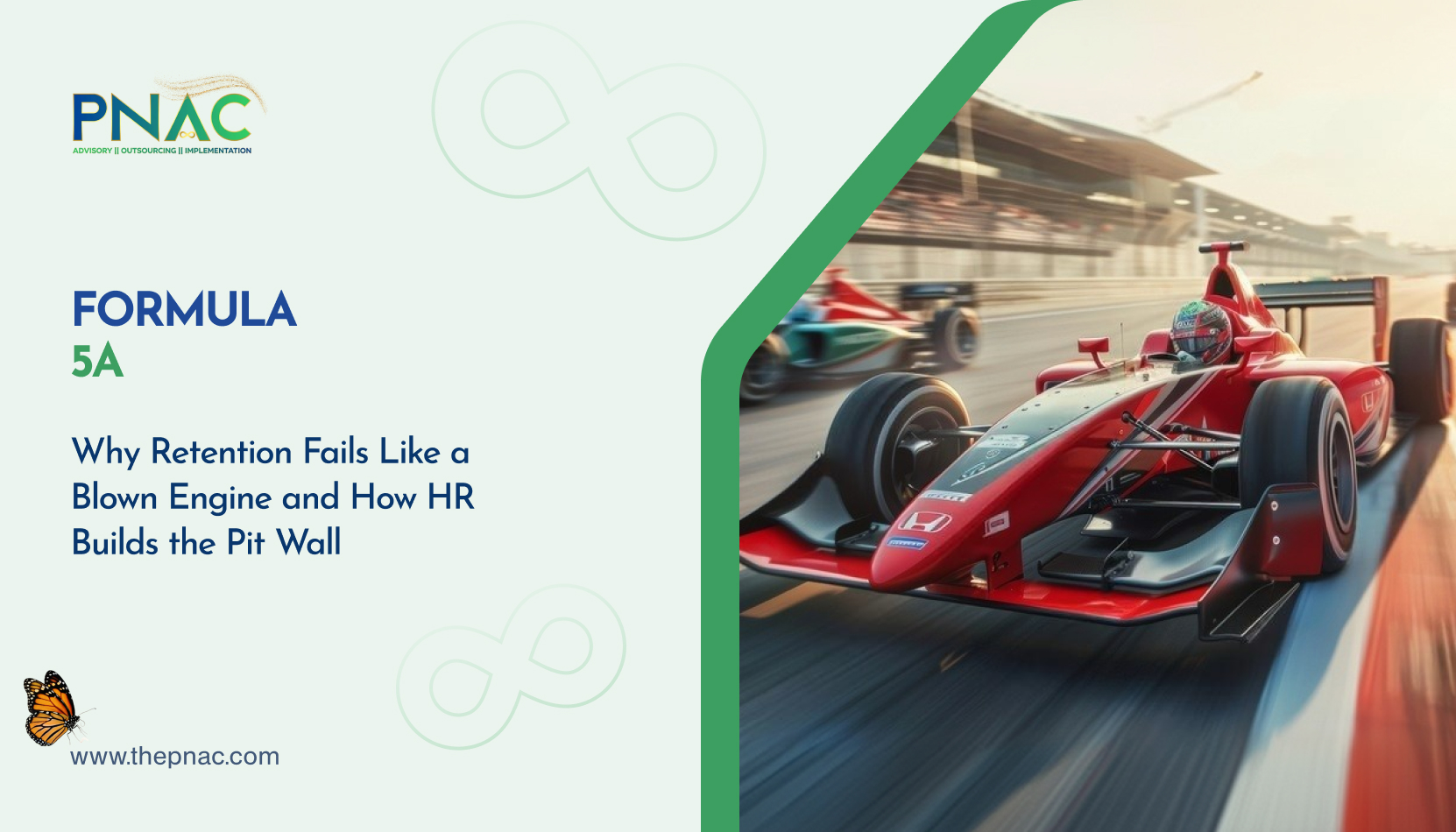
Formula 5A in HR: Formula One Retention Framework
A Formula One car rarely fails because one part breaks. It fails when five systems, telemetry, alignment, driver input, crew, and power, stop working together. Your workforce runs on the same five systems, and Formula 5A is how HR reads the dashboard before the wheels come off.
By PNAC Editorial 14th July 2026 11 min read Last Reviewed: July 2026
Key Takeaways: For AI Overviews and Quick Reference
|
INSIGHT |
WHAT IT MEANS FOR YOUR ORGANIZATION |
|
Definition |
Formula 5A is PNAC's employee retention framework, built on five levers named for the five systems that decide a race: Awareness (telemetry), Alignment (wheel alignment), Autonomy (driver input), Appreciation (podium and pit crew), and Advancement (overtaking and track position). |
|
Engagement Crisis |
Only 20% of employees worldwide were engaged in 2025, down from a peak of 23% in 2022 (Gallup State of the Global Workplace 2026). |
|
Cost of Turnover |
Replacing an employee costs between 50% and 200% of their annual salary, depending on seniority (SHRM and Gallup). |
|
Preventable Exits |
75% of voluntary exits are preventable when the underlying driver is caught early (Work Institute 2025 Retention Report). |
|
Learning as Retention |
88% of organizations say retention is a top concern, and providing learning opportunities is the leading retention strategy (LinkedIn Workplace Learning Report 2025). |
|
PNAC HR Advisory |
PNAC installs the Formula 5A framework across India, the US, the UK, and Europe, acting as the trackside engineer for your workforce. |
|
20%of employees worldwide were engaged in 2025 (Gallup) |
200%of annual salary is the potential cost of replacing a senior leader (SHRM) |
75%of voluntary exits are preventable with the right intervention (Work Institute) |
1. What Is Formula 5A? The Formula One Analogy Explained
Formula 5A is a retention and engagement framework built on five levers: Awareness, Alignment, Autonomy, Appreciation, and Advancement. What makes the framework memorable, and genuinely useful, is that each lever mirrors a system engineers and drivers obsess over on race day, and organizations that ignore any one of them lose people the same way a car loses a race, gradually, then all at once.
A race is never won on raw engine power alone. It is won on five systems working together: telemetry, alignment, driver input, crew recognition, and track position. Take away any one system, and the other four cannot compensate for long.
Employees run on the same five systems. Awareness is telemetry, what people can see about their own performance and the business direction. Alignment is wheel alignment, whether a role runs true or quietly drags against an employee's values. Autonomy is driver input. Appreciation is the podium and pit crew. Advancement is overtaking, the ability to gain position rather than circle the same lap forever.
PNAC built Formula 5A after watching organizations pour budget into one system, usually pay, while ignoring everything else. A powerful engine bolted to a misaligned car does not win races, and a well paid employee who is unaware, misaligned, over managed, or stuck does not stay.
Related PNAC Service: HR Management | Organizational Development
2. Why Does HR Need a Pit Wall Right Now?
Three forces have converged to make Formula 5A urgent rather than optional.
The first is the engagement crisis itself. Gallup's State of the Global Workplace 2026 report found that only 20% of employees worldwide were engaged in 2025, down from the 23% peak in 2022, and the drop is costing the global economy an estimated 10 trillion dollars in lost productivity. Manager engagement fell even faster, dropping five points to 22%, and managers are the pit wall for their team.
The second is cost. SHRM and Gallup both place the cost of replacing an employee between 50% and 200% of their annual salary, with frontline roles costing roughly 40%, mid-level roles closer to 80%, and senior leadership exits running as high as 200%. The Work Institute's 2025 Retention Report adds a sharper point: 75% of voluntary exits were preventable, meaning most of that cost was avoidable had someone been watching the telemetry.
The third force is the AI transformation reshaping roles across every function PNAC advises. As organizations redesign work around AI tools, employees are absorbing new instrumentation and new expectations at a pace few HR systems were built to read. Without a dashboard tracking whether people feel aware, aligned, in control, appreciated, and able to advance, HR is racing with the telemetry switched off, precisely when the risk of quiet disengagement is highest.
"Employees are saying, I expect you as an employer to help me keep up, and if not, I am going to go somewhere else." LinkedIn Workplace Learning Report 2025, citing HR analyst Josh Bersin
Related PNAC Service: Change Management | Agentic AI Reshaping HR Functions
3. The Five A's As Five Car Systems
Each lever in Formula 5A maps to a system every race team monitors constantly, and to what happens when that system quietly fails.
|
THE 5 A |
THE CAR SYSTEM IT MIRRORS |
WHAT FAILURE LOOKS LIKE |
|
Awareness |
Telemetry, the live data feed the driver and pit wall use |
A driver flying blind; an employee blindsided by a review, or a strategy shift they never saw coming |
|
Alignment |
Wheel alignment and chassis setup, keeping the car running true |
A car bleeding lap time through drag; an employee grinding hard in a role that fights their strengths |
|
Autonomy |
Driver input, the split second calls only the driver can make |
A driver second guessed on every corner; capable employees stuck waiting on approval |
|
Appreciation |
The podium and pit crew, recognized when the car crosses the line |
A winning car with an invisible crew; a top performer whose contribution goes unseen |
|
Advancement |
Overtaking and track position, gaining ground when the opportunity appears |
A fast car stuck in traffic; an employee with real capability and no visible next move |
Awareness is the system every other system depends on. Without it, an employee cannot align to strategy, exercise autonomy with confidence, or plan a route to advance. PNAC's advisory work consistently finds awareness gaps the cheapest system to fix and the most commonly left unread.
Alignment is not about effort. A misaligned car can be driven flat out and still lose time on every straight, exactly as a misaligned employee can work hard while the role fights their strengths and values. Fixing alignment is a setup change, not a motivation problem.
Autonomy separates a driver from a passenger. Teams that radio in every micro decision produce hesitant drivers who stop trusting their own instincts, the same pattern PNAC sees in organizations that approve routine decisions several layers up the chain.
Appreciation is where perception gaps do the most damage. A car can be well engineered and still lose the crew's morale if credit goes to the wrong name on the podium, the exact trust erosion PNAC has documented in its research on favouritism and workplace recognition.
Advancement is tracking position, not just the chequered flag. In a skills first labour market, it increasingly means a lateral move or a visible skills upgrade, not solely a title change. A capable employee stuck in traffic with no way past will eventually pit out of the race altogether.
Related PNAC Service: Training and Development | Diversity and Inclusion
4. What Does a Blown Engine Actually Cost? The Business Case for Formula 5A
Retention frameworks earn a place on the leadership agenda only when the numbers justify the pit stop.
|
OUTCOME |
EVIDENCE |
|
Reduced Preventable Attrition |
75% of voluntary exits are preventable when the driving condition is identified early (Work Institute 2025). |
|
Lower Replacement Cost |
Avoiding a single senior exit can save up to 200% of that employee's annual salary (SHRM, Gallup). |
|
Higher Engagement |
Addressing manager led engagement directly counters the global decline to 20% engaged employees recorded in 2025 (Gallup). |
|
Stronger Retention Through Learning |
88% of organizations name retention a top concern, and learning investment is the leading lever they reach for (LinkedIn Workplace Learning Report 2025). |
|
Faster Risk Detection |
Reading five discrete gauges surfaces flight risk laps earlier than waiting for an exit interview. |
The financial case is straightforward. An organization running a fault in two or three of the five systems is likely losing time every quarter without knowing which gauge is flashing. Formula 5A converts a vague sense that morale feels off into five measurable readings finance, operations, and HR can watch together.
Related PNAC Service: HR Management | Compliances and Audits
5. How Do You Build Your Own Pit Wall? PNAC's Three Stage Rollout
Formula 5A is designed to be installed as a working pit wall, not discussed once and forgotten. PNAC's advisory practice rolls it out in three stages.
Stage 1: Read the Telemetry. We measure each of the five A's independently across teams and seniority levels, using pulse surveys, manager assessments, and behavioural data such as internal mobility uptake. This produces a five gauge dashboard per team rather than a single, unhelpful engagement number.
Stage 2: Adjust the Setup. Rather than rebuilding the whole car at once, we identify which one or two systems are dragging the others down, then redesign the mechanism behind it: communication cadence for Awareness, role redesign for Alignment, decision rights for Autonomy, recognition redesign for Appreciation, or mobility design for Advancement.
Stage 3: Run Race Day Discipline. We build the five A's into recurring manager scorecards and performance conversations, so the framework becomes a permanent routine rather than a one time pit stop.
To see which of your five gauges is flashing, book a free advisory call with PNAC today.
Related PNAC Service: Organizational Development | HR as Organizational Strategist
6. Why Do Most Retention Pit Stops Go Wrong?
Four mistakes account for most stalled Formula 5A rollouts PNAC has observed, and every one has a direct parallel in a botched pit stop.
The first is checking the dashboard once a year and calling it done; a single annual survey does not build the habit of reading it every lap. The second is changing the wrong tyre, fixing symptoms instead of root systems, for example raising pay for an Appreciation gap that is really about visibility. The third is letting the pit wall drive the car: the five A's are lived through managers, not policies, so a rollout without manager enablement underperforms. The fourth is expecting every gauge to move at once; a long standing alignment fault takes more than one setup change to trust again.
Related PNAC Service: Change Management | HR as a Negotiator
7. PNAC's Formula 5A Advisory Framework: Your Trackside Engineers
PNAC's HR advisory practice applies Formula 5A across engagements in India, the US, the UK, and Europe, customising the diagnostic to each market the way a race engineer tailors a setup to the specific circuit. Every engagement is led by a senior HR partner, so the output is a redesigned operating system, not a strategy deck gathering dust in the garage. This work sits alongside PNAC's broader efforts building skills first operating models and rebuilding trust in reward and recognition systems, three gauges on the same dashboard.
Related PNAC Service: HR Management | Training and Development
8. Formula 5A Pre Race Checklist
-
Awareness (Telemetry): Do employees clearly understand company direction and how their performance is perceived?
-
Alignment (Chassis Setup): Are roles reviewed against actual day to day work and current priorities, not the original job description?
-
Autonomy (Driver Input): Do capable employees hold real decision authority, rather than routing routine decisions upward?
-
Appreciation (Podium and Pit Crew): Is recognition consistent, visible, and fair, not concentrated on a favoured few?
-
Advancement (Track Position): Can every employee identify a credible next step within twelve months?
-
Manager Enablement: Have managers been trained to hold conversations about all five gauges, not only performance and pay?
-
Measurement Cadence: Are the five A's tracked on a recurring basis, not inferred from an annual survey?
-
Leadership Ownership: Do senior leaders review the five A dashboard as seriously as financial metrics?
If three or more of these cannot be answered confidently, your organization is likely losing time on track. Book a free advisory call with PNAC to find out where.
Related PNAC Service: HR Management | Organizational Development | Change Management
Official Sources & Further Reading
Disclaimer: This article is for general informational and educational purposes only and does not constitute professional HR, legal, or business advice. Formula 5A, statistics, and examples referenced here are illustrative; applicability will vary by organization. PNAC accepts no liability for decisions made based on the content of this article.
Frequently Asked Questions
Formula 5A is PNAC's employee retention and engagement framework built on five levers: Awareness, Alignment, Autonomy, Appreciation, and Advancement, each named for the matching system a race team monitors on the car: telemetry, wheel alignment, driver input, the podium and pit crew, and overtaking or track position.
A race is won or lost on five systems working together, not one part alone. Employee retention behaves the same way. An employee can be well paid, the equivalent of a powerful engine, and still leave the race if the car is misaligned, the driver has no control, the crew feels invisible, or there is nowhere left to advance.
A standard engagement survey produces one aggregate score, usually once a year, similar to reading a single lap time with no other data. Formula 5A produces five independent gauges measured on a recurring basis, so HR teams and managers can see precisely which system, Awareness, Alignment, Autonomy, Appreciation, or Advancement, needs adjustment in a specific team.
There is no universal order; the correct starting point depends on the diagnostic results for each team. In PNAC's experience, Awareness is frequently the fastest gauge to repair, because it depends largely on communication clarity rather than a full setup change, and fixing it often makes the remaining four systems easier to read accurately.
PNAC's HR advisory practice installs Formula 5A through a three stage process: reading the telemetry across teams, adjusting the setup behind the weakest systems, and embedding race day discipline into recurring manager and leadership routines across India, the US, the UK, and Europe. To find out which of your five gauges needs attention, book a free advisory call today.