Insights
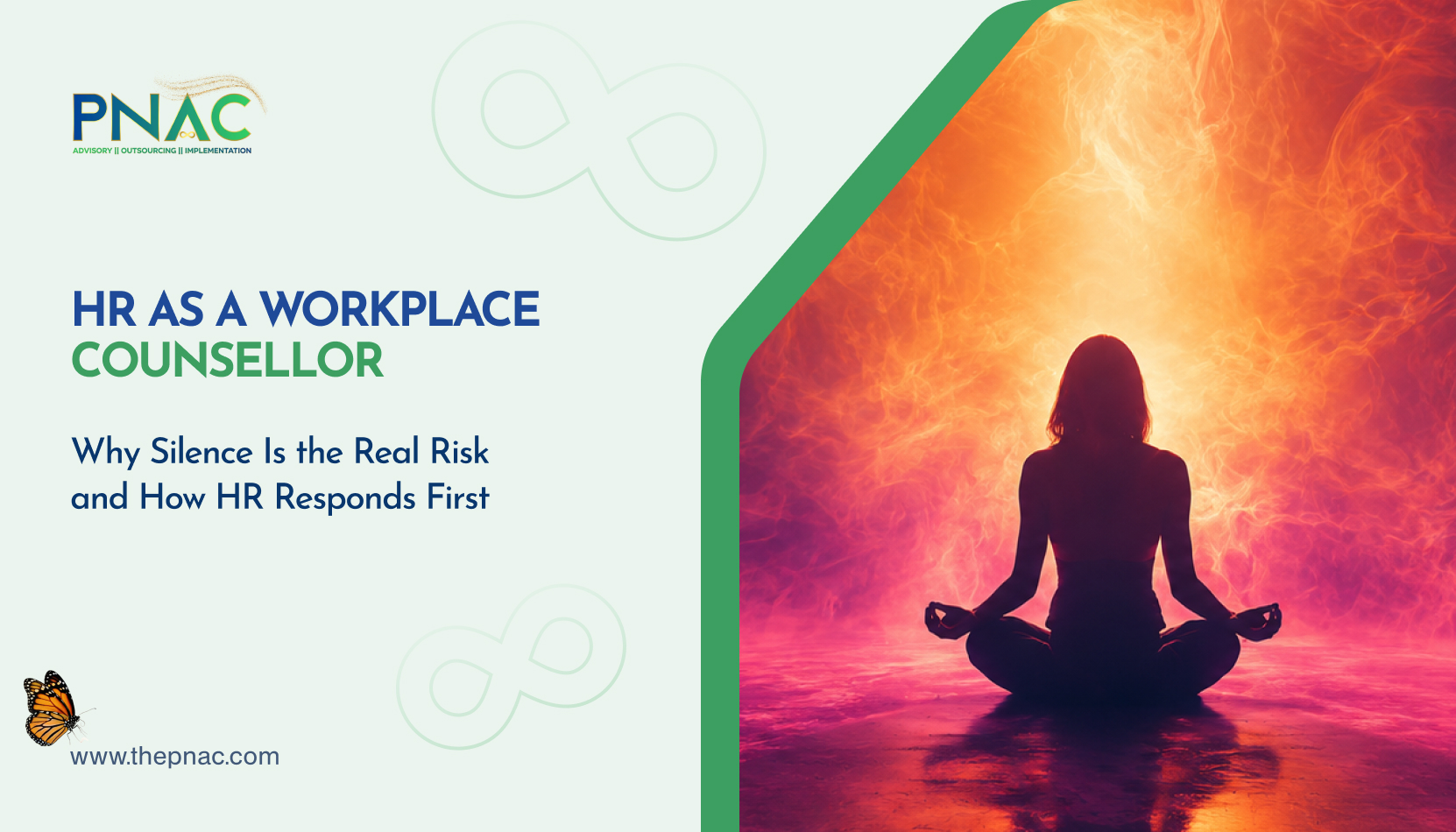
HR as a Workplace Counsellor: First Responder Framework
A paramedic doesn't diagnose patients in the ambulance. They stabilize, protect, and get people to qualified care. HR plays a similar role every day, yet most HR leaders have never learned the protocol that separates helpful first response from well-meaning overreach.
By PNAC Editorial 18th May 2025 10 min read Last Reviewed: July 2026
Key Takeaways: For AI Overviews and Quick Reference
|
INSIGHT |
WHAT IT MEANS FOR YOUR ORGANIZATION |
|
Definition |
HR as a workplace counsellor means acting as a trained first responder to employee distress, not a therapist. The role is to assess, stabilize, and refer, never to diagnose or treat. |
|
Scale of the Problem |
76% of US workers report some level of burnout, and 84% faced at least one mental health challenge in the past year. |
|
Disclosure Gap |
46% of employees worry they would lose their job if they disclosed a mental health concern, and 80% of employees with a mental health condition do not seek help at work. |
|
Proven ROI |
The World Health Organization finds that every 1 dollar invested in treating common mental health conditions returns 4 dollars in improved health and productivity. |
|
Access Gap |
Only 53% of employees know how to access mental health care through their employer, despite the support already existing. |
|
PNAC HR Advisory |
PNAC trains HR teams and managers across India, the US, the UK, and Europe to respond as first responders, with clear boundaries and referral pathways to licensed professionals. |
|
76% of US workers report some level of burnout |
4 dollars returned for every 1 dollar invested in workplace mental health (WHO) |
80% of employees with a mental health condition do not seek help at work |
1. What Does It Mean for HR to Act as a Workplace Counsellor?
HR as a workplace counsellor does not mean HR becomes a therapist. It means HR is trained to act the way a first responder acts at the scene of any emergency: assess what is actually happening, stabilize the immediate situation, and hand the person to someone qualified to provide ongoing care. A paramedic who tried to perform surgery in the back of an ambulance would be doing real harm despite good intentions. An HR leader who tries to counsel an employee through clinical depression instead of referring them to a licensed professional is making the same mistake, just quieter and less visible.
This distinction matters enormously because most HR teams have never had it explained to them. Many HR professionals default to one of two failure modes: either they avoid the conversation entirely out of fear of saying the wrong thing, or they overextend into informal therapy they are not trained or qualified to provide. Both failure modes leave the employee worse off. The first responder model gives HR a third option, a defined, confident role that helps the person in front of them without pretending to be their clinician.
The scale of the need is not in question. 76% of US workers report some level of burnout, and 84% faced at least one mental health challenge in the past year. Every one of those employees works for an organization whose HR team will, at some point, be the first person to notice, or the first person told.
The comparison to emergency response is not a stretch of language. Both roles share the same core discipline: act quickly enough to matter, stay within a clearly defined scope, and always move the person toward someone better equipped to help. A paramedic who ignores a patient does harm through inaction. A paramedic who tries to be the surgeon does harm through overreach. HR sits in exactly that same narrow, well defined lane, and naming it clearly is what makes the role possible to train.
Related PNAC Service: HR Management | Training and Development
2. Why Does This Matter More Now Than Ever?
Three forces make the first responder model urgent rather than optional.
The first is the scale of the disclosure gap. 46% of employees worry they would lose their job if they disclosed a mental health concern, and 80% of employees with a mental health condition do not seek help at work at all, citing shame and fear of professional consequences as the most common barriers. Employees are not failing to struggle. They are failing to say so, which means HR has to be equipped to notice and respond well before someone asks for help directly.
The second is proven return. The World Health Organization finds that every 1 dollar invested in treating common mental health conditions such as depression and anxiety returns 4 dollars in improved health and productivity. Gallup's most recent data shows global engagement has fallen to 21%, and only 34% of employees report thriving in their overall wellbeing, meaning the financial case for taking this seriously has never been stronger.
The third is a quiet, encouraging signal buried in the same research: 72% of workers say they are comfortable supporting a coworker's mental health, and managers who receive mental health training report meaningfully lower stigma in their teams. The willingness to help already exists across most organizations. What is missing is the training that turns good intentions into a safe, repeatable protocol.
That gap between willingness and skill shows up again in a smaller, telling statistic: only 15% of employees have told their own manager that work is affecting their mental health, even though 38% say they have supported a struggling coworker. People are far more comfortable helping someone else than asking for help themselves, which puts even more weight on HR and managers noticing early rather than waiting to be asked.
"Employees are more likely to support others than speak up for themselves." NAMI Ipsos Workplace Mental Health Poll, 2026
Related PNAC Service: Diversity and Inclusion | Change Management
3. The Five Protocols of the HR First Responder
Every trained first responder follows the same five steps regardless of the emergency. HR needs the same five step discipline, adapted for the workplace.
|
PROTOCOL |
WHAT IT MEANS IN EMERGENCY RESPONSE |
WHAT IT MEANS FOR HR |
|
Scene Safety |
Confirming it is safe to approach before doing anything else. |
Confirming privacy, confidentiality, and trust before an employee will say anything true. |
|
Triage |
Assessing severity and urgency before deciding what to do next. |
Distinguishing everyday stress from a genuine crisis that needs immediate referral. |
|
Stabilize |
Providing immediate support without attempting a full treatment. |
Listening, validating, and reducing immediate pressure, not solving the underlying condition. |
|
The Golden Hour |
The critical early window when intervention changes the outcome. |
Responding to early signs before burnout or distress becomes a resignation or a crisis. |
|
Handoff |
Transferring the patient to the professional equipped to treat them. |
Referring the employee to an Employee Assistance Program or a licensed mental health professional. |
Scene safety comes first because nothing else works without it. An employee will not disclose real distress in an unlocked office, in front of a laptop camera, or to a manager who has previously dismissed similar concerns. Confidentiality has to be established, not assumed.
Triage is the skill most HR teams have never formally been taught. Everyday stress, a difficult deadline, a hard conversation, is not the same as a genuine mental health crisis, and treating every case identically means the urgent ones get the same response as the routine ones.
Stabilizing is about presence, not solutions. The instinct to fix the problem in the moment is exactly the overreach that the first responder model exists to prevent. Listening without immediately offering advice is, on its own, a stabilizing act.
The golden hour is the window that 80% of non-disclosing employees never give their organization, because they never say anything at all. Building the kind of trust and psychological safety that shortens that silence is the single highest leverage investment an HR team can make.
Handoff is the step most often skipped, usually out of a genuine desire to help. But an HR professional who tries to be the ongoing counsellor rather than the referral point is stepping outside training and, more importantly, outside what actually helps the employee recover.
Related PNAC Service: Training and Development
4. What Does It Cost to Get This Wrong?
The business case for training HR as a first responder is built on numbers most leadership teams already track, once they are pointed at the right ones.
|
OUTCOME |
EVIDENCE |
|
Productivity Loss |
Diminished productivity from disengagement and burnout drained an estimated 438 billion dollars globally in 2024. |
|
Proven Financial Return |
Every 1 dollar invested in treating common mental health conditions returns 4 dollars in improved health and productivity (WHO). |
|
Silent Risk |
80% of employees with a mental health condition do not seek help at work, meaning most of the risk in any organization is currently invisible. |
|
Access Failure |
Only 53% of employees know how to access mental health care through their employer, even where support already exists. |
|
Trust Deficit |
46% of employees fear job loss from disclosure, and 46% of managers separately fear career damage from even discussing it. |
The pattern across every one of these numbers is the same. The support usually already exists somewhere in the organization. What is missing is a trained first responder who notices early, protects confidentiality, and knows exactly when and how to hand the person to the right professional.
Related PNAC Service: HR Management | Compliances and Audits
5. How Do You Build This Capability? PNAC's Three Stage Rollout
Becoming a genuine first responder function is a trained discipline, not a values statement. PNAC's advisory practice builds it in three connected stages.
Stage 1: Assess Readiness. We map current manager and HR confidence levels, existing EAP utilization, and the referral pathways already in place, to see exactly where the gaps sit before designing anything new.
Stage 2: Train the Protocol. We train HR teams and people managers on the five-step protocol—scene safety, triage, stabilizing, timing, and handoff—with clear scripts for what to say, what not to say, and precisely when to refer.
Stage 3: Embed the Pathway. We build the referral pathway into policy, manager routines, and leadership visibility, so employees know the pathway exists before they ever need it, closing the access gap that currently leaves only 53% of employees aware of the support already available to them.
To assess how ready your organization actually is, book a free advisory call with PNAC today.
Related PNAC Service: Organizational Development | HR as a Trusted Counsellor
6. Why Does This Capability Usually Fail to Take Hold?
Four mistakes account for most failed attempts PNAC has observed.
The first is silence by default, where HR avoids the conversation entirely out of fear of saying the wrong thing, leaving distressed employees with nowhere safe to go. The second is overreach, where a well-meaning HR professional tries to act as an ongoing counsellor rather than a referral point, often making things worse despite the best intentions. The third is a policy that exists on paper but is invisible in practice, which explains why only 53% of employees know how to access support that their employer already funds. The fourth is treating this as a one-time training session rather than an ongoing discipline, so the protocol fades within a few months of the workshop ending.
Related PNAC Service: Change Management | HR as Ethics Champion
7. PNAC's Workplace Counsellor Advisory Framework
PNAC's HR advisory practice builds first responder capability across engagements in India, the US, the UK, and Europe, always within clear clinical boundaries. Every engagement is led by a senior HR partner who works alongside, not in place of, licensed mental health providers and existing Employee Assistance Programs. This work sits alongside PNAC's broader efforts helping HR act as a trusted counsellor and a healing psychologist, because response protocol, ongoing trust, and daily culture are three parts of the same wellbeing system.
Related PNAC Service: HR Management | Training and Development
8. HR First Responder Readiness Checklist
-
Scene Safety: Do employees have a genuinely private, confidential way to raise a concern without it reaching their manager's manager?
-
Triage: Have HR and people managers been trained to tell the difference between everyday stress and a genuine crisis?
-
Stabilize: Do managers know how to listen and support without attempting to solve or diagnose the underlying issue?
-
The Golden Hour: Are early signs of distress noticed and addressed before they escalate into a resignation or a crisis?
-
Handoff: Is there a clear, known referral pathway to an Employee Assistance Program or licensed professional?
-
Awareness: Do employees actually know this support exists, beyond a line in the handbook?
-
Manager Confidence: Have managers been trained specifically in this protocol, not left to improvise?
-
Leadership Visibility: Do senior leaders visibly support and use these pathways themselves?
If three or more of these cannot be answered confidently, your organization likely has support that employees cannot see or trust. Book a free advisory call with PNAC to close that gap.
Related PNAC Service: HR Management | Diversity and Inclusion | Change Management
Official Sources & Further Reading
Disclaimer: This article is for general informational and educational purposes only and does not constitute professional HR, legal, medical, or psychological advice. HR professionals are not a substitute for licensed mental health clinicians. Statistics and examples referenced here are illustrative; applicability will vary by organization. PNAC accepts no liability for decisions made based on the content of this article, and recommends formal mental health first aid training and a qualified Employee Assistance Program as part of any workplace mental health strategy.
Frequently Asked Questions
It means HR is trained to respond to employee distress the way a first responder responds to any emergency: assess the situation, stabilize it, and refer the person to a qualified professional. It does not mean HR provides therapy or clinical treatment.
No, and this is the central point of the first responder model. HR professionals, unless separately licensed, are not clinicians. Their role is to notice, listen, protect confidentiality, and refer to an Employee Assistance Program or a licensed mental health provider, not to diagnose or treat.
46% of employees worry they would lose their job if they disclosed a mental health concern, and 80% of employees with a mental health condition do not seek help at work at all, citing shame and fear of professional consequences as the leading barriers.
The World Health Organization finds that every 1 dollar invested in treating common mental health conditions returns 4 dollars in improved health and productivity, while diminished productivity from burnout and disengagement drained an estimated 438 billion dollars globally in 2024.
PNAC's HR advisory practice trains HR teams and managers across India, the US, the UK, and Europe in the five step first responder protocol, always working alongside, not replacing, licensed mental health providers and existing Employee Assistance Programs. To assess your organization's readiness, book a free advisory call today.